NALVEM · Guides
3D wallpaper or 3D plaster wall panels: the real differences, cost and which to choose
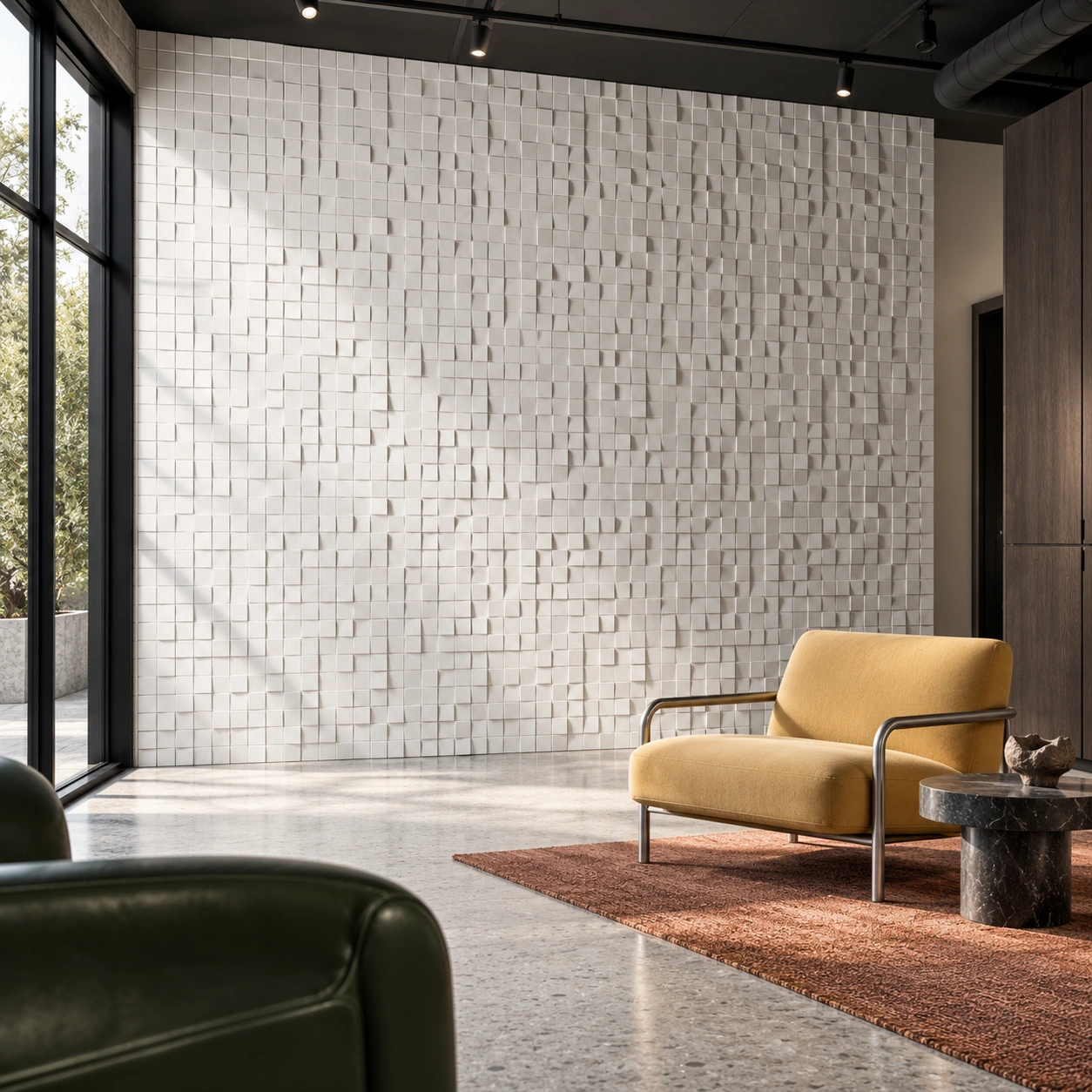
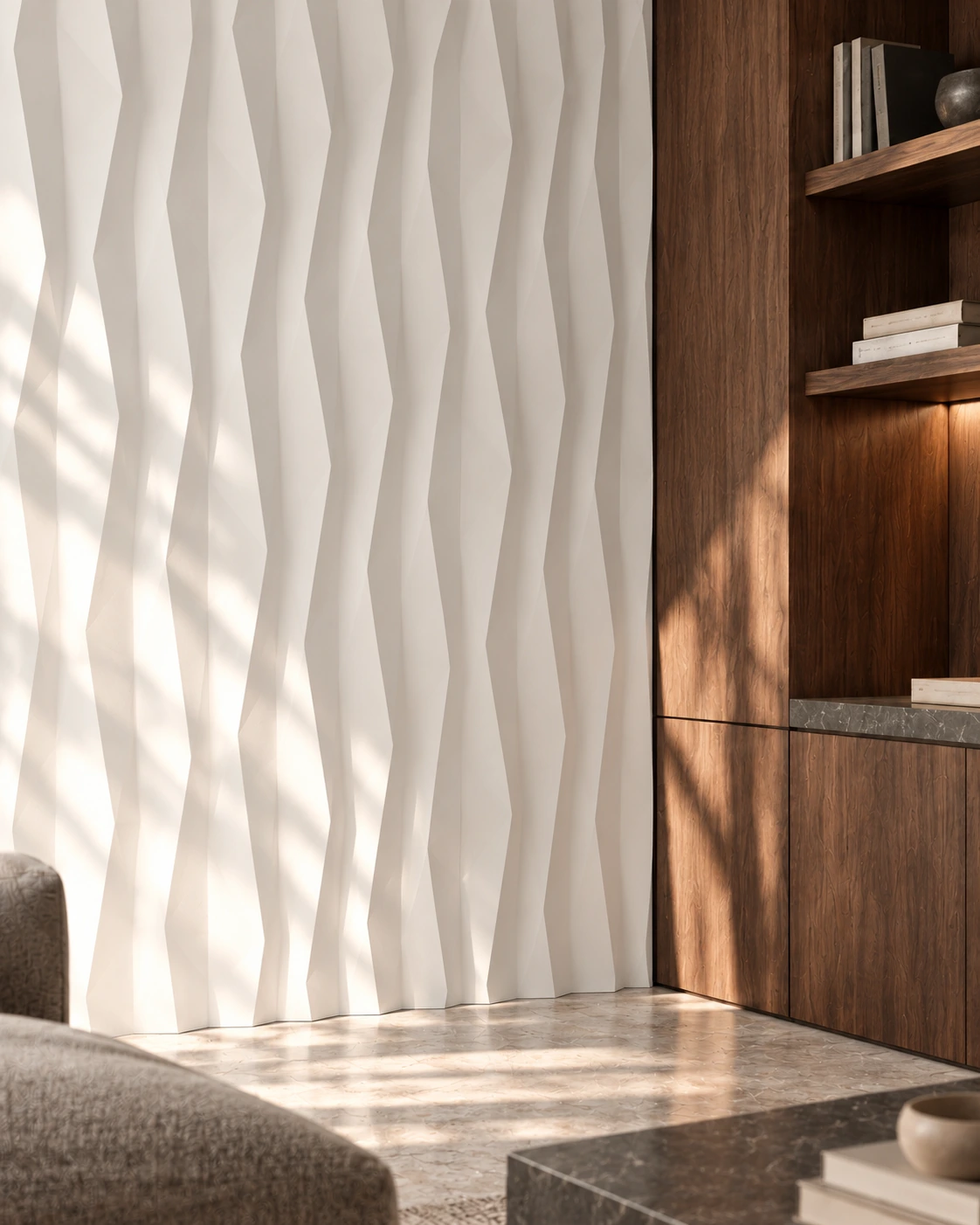
Key points
- 3D wallpaper is usually an effect: a printed pattern or a shallow texture that imitates depth. A 3D plaster wall panel has real relief and is 8 to 30 mm thick, depending on the design.
- The difference shows up close and in raking light: real relief casts shadows that change through the day; a printed shadow always stays the same.
- Wallpaper is usually cheaper and easier to change. NALVEM panels have a planned price of €112/m² including Irish VAT (23%) and are a long-lasting wall covering.
- Panels are not fitted over wallpaper: the paper is stripped first and the substrate repaired.
- For a rental or a quick change, wallpaper makes sense. For the main wall of a home or a business, real relief makes the difference.
You have saved two photos of a white wall with relief. One is 3D wallpaper and the other a 3D plaster wall panel, and on your phone screen they look almost identical. Their prices, however, are nothing alike, and neither is the way they are put up. This guide explains what lies behind each one, how each option looks on your wall rather than in a photo, and which suits your situation: a rental, a quick makeover, a living room or premises open to the public.
What 3D wallpaper actually is
‘3D wallpaper’ is a sales label, not a type of material. Very different products are sold under that name, and it is worth separating them before comparing anything.
Wallpaper with a printed 3D effect
This is a flat paper with a pattern that imitates depth: brick, stone, wood, slats, waves or cubes in perspective. The effect comes from the print, which draws light and shadow on a smooth surface. It is what many shops call 3D effect wallpaper or panel-effect wallpaper. From a distance and head-on it can be convincing; up close or at an angle, the wall is flat.
Textured wallpaper: embossed, vinyl and textures
Here there is some relief. Textured wallpaper is made with an embossed, blown or textured surface that you can feel: leaves, lines, grids, imitation linen or stone. Many are vinyl wallpapers, with a plastic top layer that makes them more washable. The relief is usually shallow and varies from product to product. It is enough to add texture, not to create architectural volume.
Self-adhesive wallpaper and foam panels sold as ‘3D wallpaper’
Searching for self-adhesive 3D wallpaper also brings up thin foam or plastic sheets with an adhesive back, often shaped like brick or stone. They are sold as wallpaper, but they are small padded sheets. They go up quickly and without tools. How well they stay put depends a great deal on the substrate and the room: on dusty walls, flaky paint or with changes in temperature, they can come away over time. Check what each manufacturer states.
All three have something in common: they are light, thin and quick to put up. That is their advantage, and also their limit.
What a 3D plaster wall panel is
A 3D plaster wall panel is a solid piece with the relief formed in the material itself. In the UK and Ireland people search for ‘plaster’, and ‘gypsum’ is common in international searches; the material of NALVEM panels is a fine casting plaster, the finest and purest grade of gypsum plaster. NALVEM designs decorative 3D panels in fibre-reinforced plaster for interior walls.
- Format. Each piece measures 500 × 500 mm and covers 0.25 m²: that is 4 panels per square metre.
- Real relief. Thickness ranges from 8 to 30 mm depending on the design. The facets, curves, edges and hollows really exist; they are not drawn on.
- A continuous wall. The joints between panels are filled with plaster or fine gypsum filler and sanded. The whole surface is then primed and painted, and the wall reads as a single covering. The channels, steps and edges that belong to each design are kept.
- Finish. They will be supplied in matt white, with a fine mineral texture, ready to prime and paint on site.
- Use. Interior wall covering in dry conditions. They are not suitable for outdoors, bathrooms, showers or areas exposed to direct water or constant humidity.
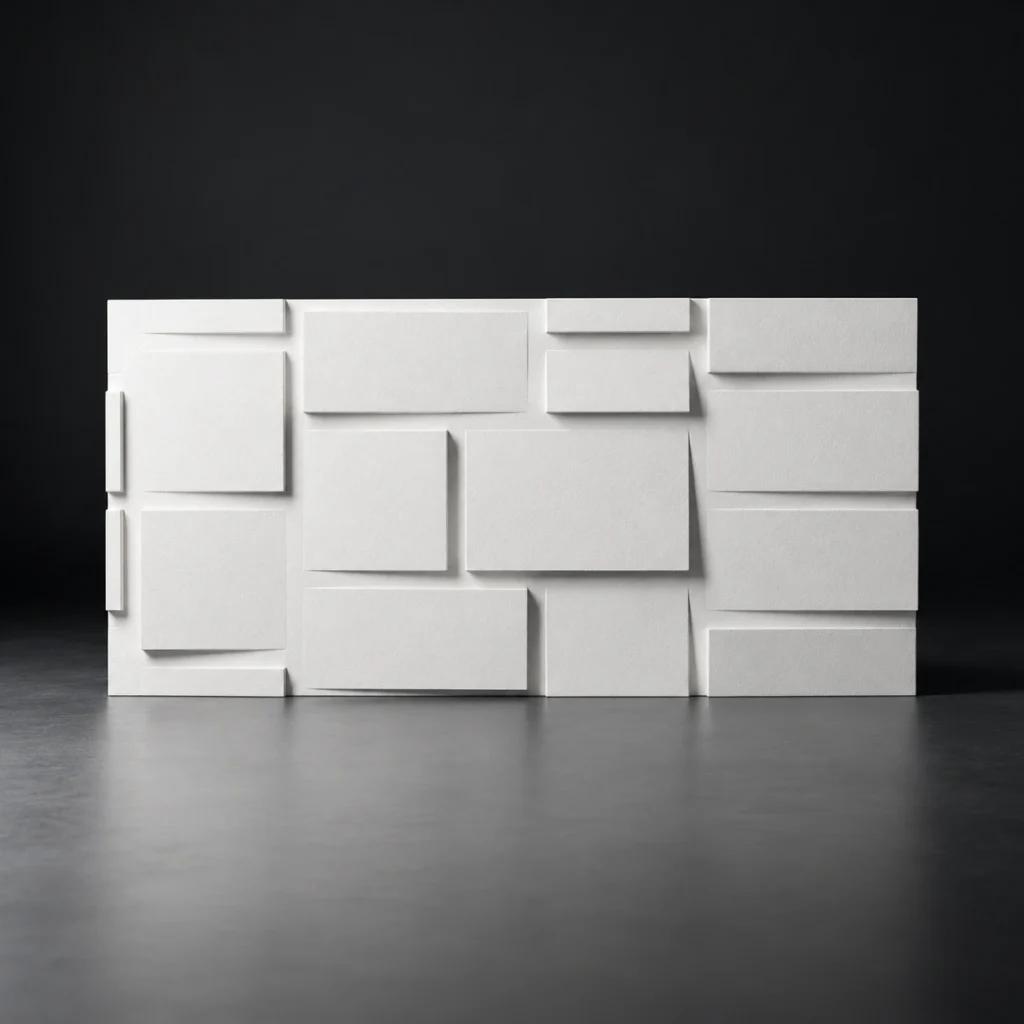
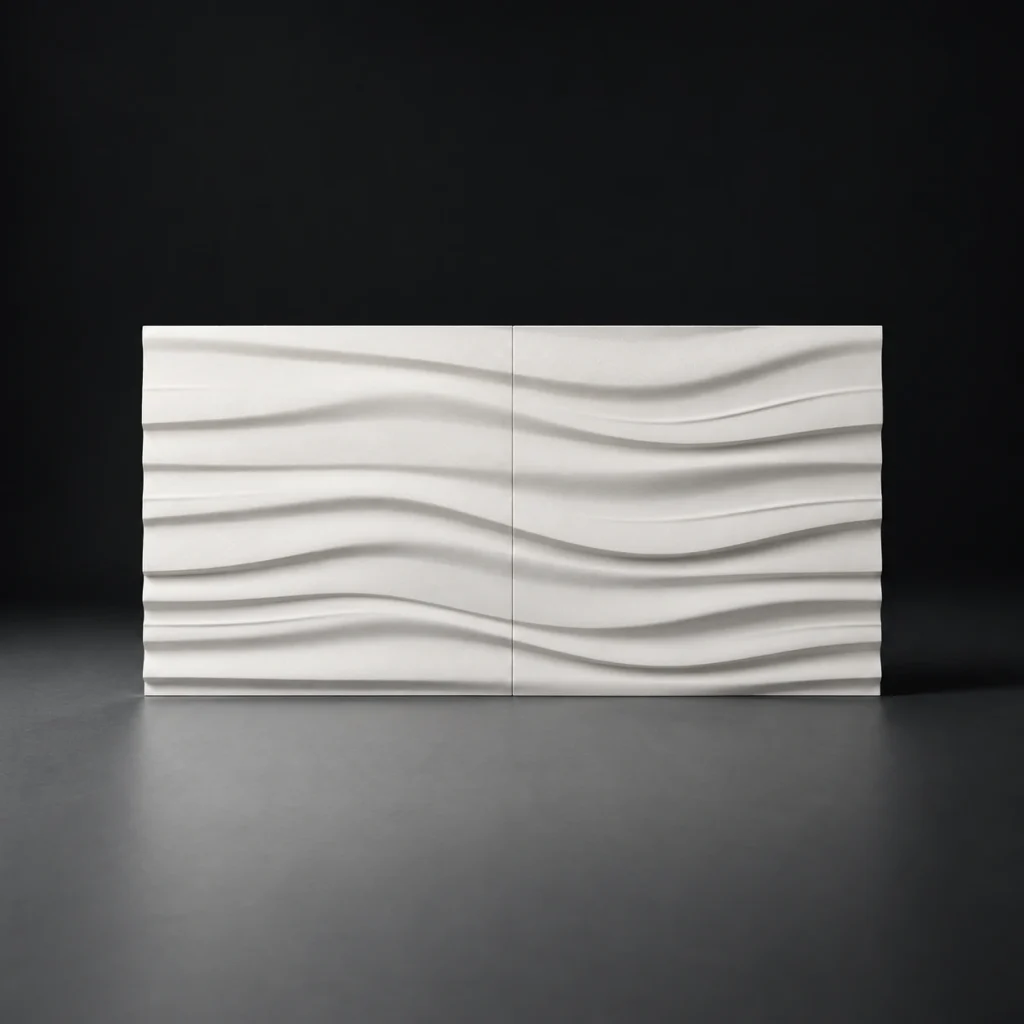
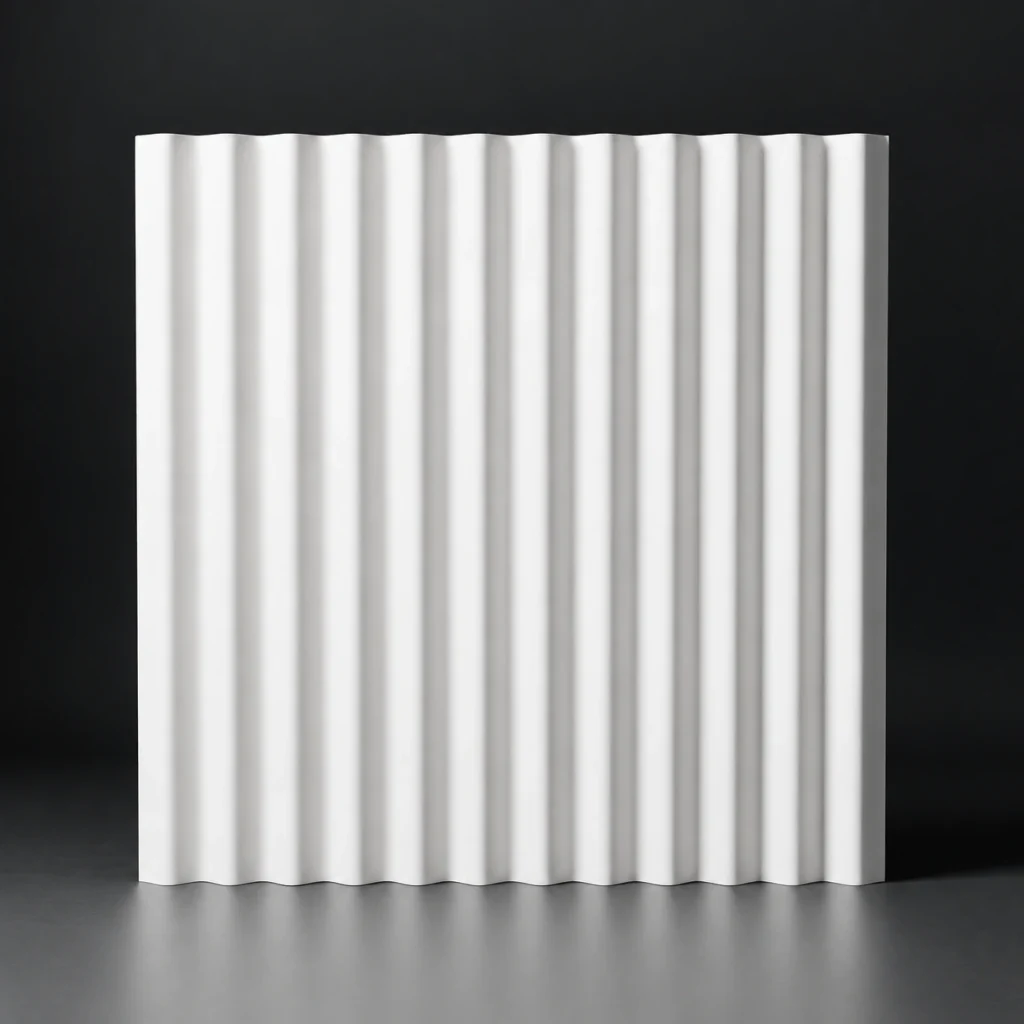
To see how a wall changes with the pattern, compare the facets of KELDRYN, the vertical folds of VELIN or the broad curvature of VORA. The full explanation of the product is in the guide to 3D plaster wall panels.
Real relief versus a 3D effect: what the photo does not show
A catalogue photo is usually taken head-on, with the lighting set up so that the pattern reads well. In those conditions, a printed paper and real relief can look the same. In your home, three things change.
Raking light
When light comes from the side, from a window or from a spotlight close to the wall, real relief casts long, crisp shadows. The deeper the relief, the clearer the pattern reads. Embossed wallpaper creates very short shadows, and printed wallpaper creates none at all: the shadow you see is ink.
Light through the day
With morning sun, afternoon light or lamps at night, the shadows on a relief panel shift and the wall changes appearance. On wallpaper with a printed 3D effect, the drawn shadows always stay in the same place. If the real light comes from the opposite side to the one the pattern imitates, the effect contradicts itself and the wall looks like what it is: flat.
Distance
From three or four metres away, many effects work. From half a metre, sitting on the sofa or walking past a wall in a hallway, you notice the texture of the paper, the sheen of the vinyl and the seams between lengths. A painted plaster panel looks, up close, like a solid wall with depth, because that is exactly what it is.
If you want the light to work on the wall, the designs in waves and folds and the linear ones change the most with the time of day.
3D wallpaper vs 3D wall panels: comparison table
This table sums up the differences. The wallpaper column contains general statements: every product is different, so always check its documentation.
| Feature | 3D wallpaper (printed, textured or self-adhesive) | 3D plaster wall panel (fibre-reinforced plaster, NALVEM) |
|---|---|---|
| Relief | None in printed paper; shallow texture in embossed or vinyl paper; a little more in foam sheets | Real relief, a piece 8 to 30 mm thick depending on the design |
| Close-up appearance | The print, the sheen of the material and the seams are visible | Matt mineral surface, like a painted solid wall |
| Joints | Seams between lengths or sheets; with 3D patterns the motif has to match | Filled with plaster or filler and sanded: a continuous wall |
| Paint and colour | Usually comes in its own colour; some are designed to be painted, others are not | Primed and painted on site in any colour; can be repainted |
| Reaction to fire | Depends on the product; check its documentation | Target: A1; documentation in preparation |
| Fitting | Quick; many are put up without a professional | Sound, flat substrate, gypsum-based adhesive, setting out and joint filling; best done by a professional |
| Removal | Usually comes off fairly easily, depending on the paper and the adhesive | A long-lasting covering: removing it means a small building job |
| Guide price | Usually cheaper per m² | Planned: €112/m², including Irish VAT (about €27.95 per panel) |
| When it fits | Rentals, quick changes, temporary decoration, tight budgets | The main wall of a home, hospitality, retail, reception areas; always dry interiors |
If you are also weighing up PVC, foam or 3D tiles, the full comparison is in PVC vs plaster wall panels, foam or 3D tiles.
Cost per m²: wallpaper versus 3D plaster wall panels
Wallpaper is usually cheaper per square metre, and self-adhesive wallpaper usually cheaper still. That is no surprise: it is a thin, light material made in rolls.
NALVEM standard panels have a planned guide price of €112/m², including Irish VAT (23%), about €27.95 per panel; the country selector on the website shows the price for other EU countries, and outside the EU it is on request. An example: a wall of 4 × 2.5 m is 10 m². That is 40 panels, 44 with a 10% allowance for waste, and the material starts at €1,229.80. Fitting, adhesive, filler, paint and delivery are quoted separately.
When comparing, bear three things in mind:
- Compare the finished wall. Wallpaper includes its colour; the panel needs primer and paint, but in return you can choose any colour and change it later.
- Think about how long it will stay. If the decoration is short-lived, wallpaper is more logical. If it is your living room wall for many years, the cost works out differently.
- Do not compare photos, compare relief. Panel-effect wallpaper and a panel with real relief do not offer the same thing, even if the photos look alike.
To work out your wall step by step, see the guide to 3D wall panel cost per m². Panels with LED light are priced on request.
Fitting and removal
Wallpaper: quick to put up and to change
Wallpaper is hung with paste on a smooth, prepared wall, and self-adhesive wallpaper by peeling off the backing. Many people put it up themselves. It also usually comes off fairly easily, although that depends on the paper, the adhesive and the condition of the wall. That ease of change is its big advantage.
The panel: a wall covering designed to stay
A 3D plaster wall panel is fitted like a permanent wall finish:
- Acclimatise the pieces for 24 hours in the room, in their packaging.
- Check that the substrate is sound, flat, dry and clean.
- Set out from a level line.
- Bond with a gypsum- or plaster-based adhesive, with additional mechanical fixing if the substrate cannot guarantee adhesion.
- Fill the joints with plaster or fine gypsum filler and sand.
- Prime the whole surface and paint with an interior paint compatible with gypsum.
We recommend fitting by a professional with experience in plaster, gypsum or tiling. Drying times are those stated by the manufacturer of the adhesive, filler or paint. You will find the details in the guide to installing 3D plaster wall panels and in the installation guide in PDF.
If your wall already has wallpaper
Panels are not fitted over wallpaper or vinyl coverings. The adhesive would grip the paper, not the wall, and the paper can come away under the weight. The paper has to be stripped first and the substrate repaired until it is sound, flat, dry and clean. Each piece weighs roughly 4 to 6 kg depending on the design, a calculated figure, not a measured one: the substrate has to be up to it.
Paint and colour
With wallpaper, the colour comes from the factory. You choose a pattern and a shade, and that is what you will have on the wall. Some textured wallpapers are designed to be painted over; many printed vinyls are not. It depends on the product; check its documentation before painting.
NALVEM panels will be supplied in matt white, ready to prime and paint on site in any colour. You can leave them white, match them to the rest of the room or paint the wall a dark shade to soften the shadows. And because it is a painted mineral surface, you can repaint it later, like any other wall.
A tip: light, matt colours let the relief read better. Dark shades reduce the contrast between light and shadow; they work well with strongly sculpted designs, such as DYAREN or those in the geometric family.
Reaction to fire in commercial premises
In a home, the reaction to fire of a decorative wall covering is rarely the first thing anyone looks at. In a restaurant, a hotel, a shop or a circulation area, it is. What is required depends on the use, the area and the project, and is set by the project designer.
- Wallpaper. Its reaction to fire depends on the product: on the backing, the vinyl layer if it has one, the inks and the adhesive. If you are going to use it in commercial premises, ask the manufacturer for the documentation supporting its class and check it with the project designer.
- NALVEM panels. The formulation is being defined with class A1 as its target; until this is documented, NALVEM does not declare a class for the product. The primer and paint applied on site are an additional coating whose behaviour depends on the product.
You can read what class A1 means in the guide to Euroclass A1. If your project is commercial premises, the guide to 3D wall panels for restaurants, hotels and commercial spaces will help you plan it.
Which to choose in each case
You are renting
Wallpaper, especially one that comes off easily, is the logical option. A 3D plaster wall panel is a covering that stays on the wall, so it only makes sense if the landlord agrees and understands that it is a permanent improvement.
You want a quick or temporary makeover
If you need to change a wall in an afternoon, for a season or on a very tight budget, textured or self-adhesive wallpaper will do. Be clear that the result will be a texture or an effect, not real volume.
It is the main wall of your home
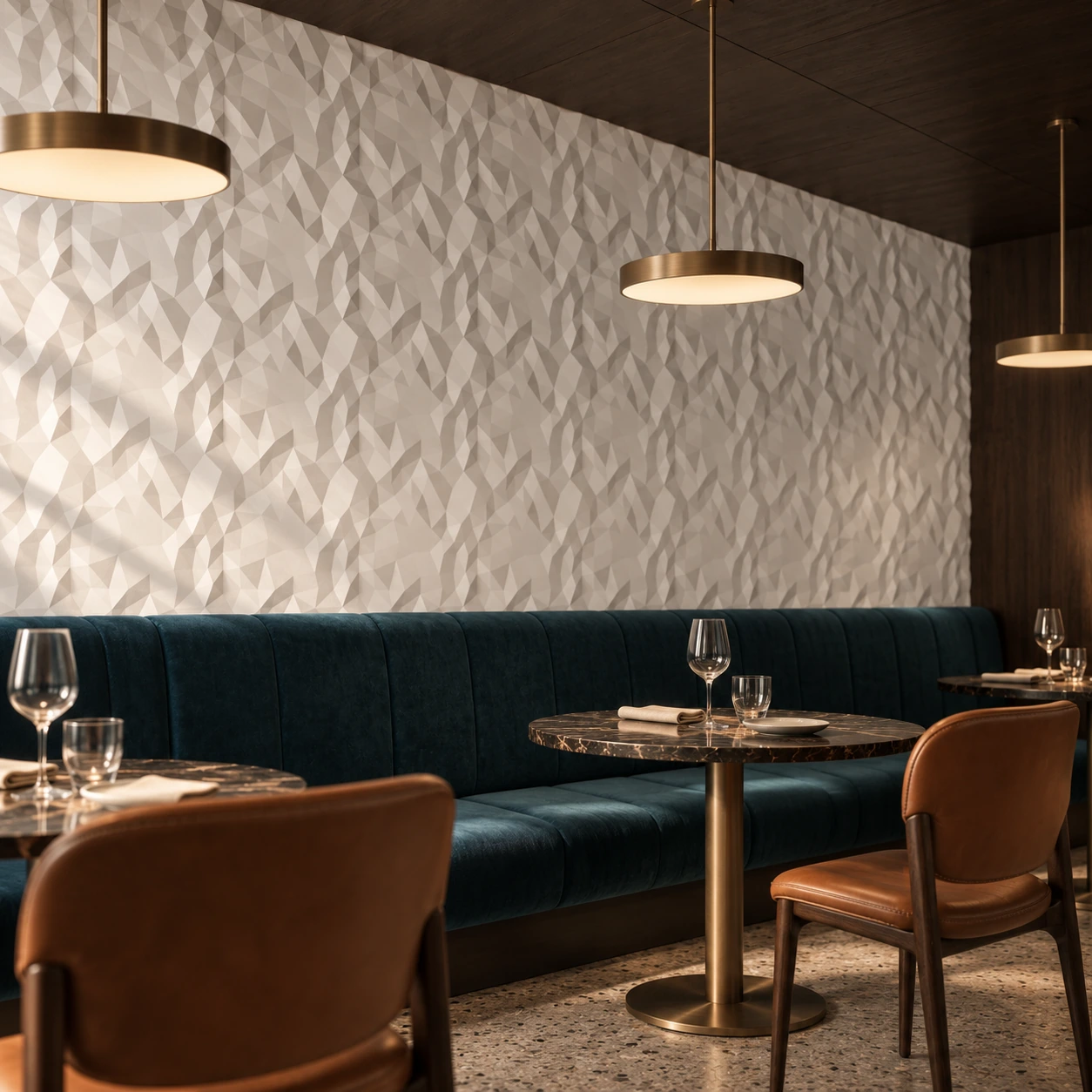
The wall behind the sofa, the bedhead wall or the end wall of the dining room are looked at every day, up close and in different light. That is where real relief shows. Plaster panels give a continuous wall, painted in the colour you want, with shadows that change throughout the day. You will find ideas in the guide to feature wall panels for the living room, bedroom and home.
It is a restaurant, a hotel or a shop
In hospitality and retail, image, heavy use and reaction to fire all count. A mineral material and a wall with no visible joints suit reception areas, dining rooms and waiting areas well. If you also want integrated lighting, look at the 3D wall panels with LED and the guide to panels with indirect lighting.
It is a bathroom or a damp area
NALVEM plaster panels are not suitable for bathrooms, showers or areas with constant humidity. For those walls, look for a material designed for water and check its documentation.
Frequently asked questions
Which is better, 3D wallpaper or 3D wall panels?
It depends on what you are looking for. 3D wallpaper is better if you want something cheap, quick and easy to change, for example in a rental. 3D plaster wall panels are better if you want real relief, a continuous wall with no visible joints, the colour of your choice and a mineral material. In return, they cost more, weigh more and are fitted like a permanent wall finish, in dry interiors only.
Can textured wallpaper be painted?
Some can: there are textured wallpapers designed precisely to be painted over. Many printed vinyls, on the other hand, do not take paint well. It depends on the product; check its documentation before painting. If you want to choose the colour freely and be able to change it later, NALVEM panels will be supplied ready to prime and paint on site.
Can you put wall panels over wallpaper?
No. Plaster panels are not fitted over wallpaper or vinyl coverings, because the adhesive would grip the paper and not the wall. The paper has to be stripped first and the substrate repaired until it is sound, flat, dry and clean. The wall is then set out from a level line and the panels bonded with a gypsum- or plaster-based adhesive.
Which is cheaper per m²?
Wallpaper is usually cheaper per square metre, and self-adhesive wallpaper cheaper still. NALVEM standard panels have a planned guide price of €112/m², including Irish VAT, about €27.95 per panel. Fitting, adhesive, filler, paint and delivery are quoted separately. Compare the cost of the finished wall and how long it is going to last.
Which lasts longer?
There is no single figure, because it depends on the product, the fitting and the use. As a general rule, a plaster panel well bonded to a sound substrate, with the joints filled and painted, behaves like a solid wall and can be repainted. Wallpaper is designed to be changed more easily, and self-adhesive products depend a great deal on the substrate and the room.
Is self-adhesive 3D wallpaper the same as a panel?
No. Many products sold as self-adhesive 3D wallpaper are thin foam or plastic sheets with adhesive. They are light and quick to put up, but their relief is shallow and their seams usually remain visible. A 3D plaster wall panel is a solid piece of fibre-reinforced plaster, 8 to 30 mm thick, bonded with a gypsum-based adhesive and blended into a continuous wall.
Which looks better in a living room?
In a living room, the wall is seen up close, from the sofa, and in light that changes through the day. That is why real relief usually gives a more architectural result than a printed effect. A wall of plaster panels, painted in a matt shade, changes with the light from the window and with the lamps. If the living room is temporary or rented, wallpaper is the practical option.
Next step
If you already know you want real relief rather than an effect, browse the full catalogue of 3D plaster wall panels and choose a design; RILLA, with its twelve vertical waves, is a good starting point for a living room. On each design’s page you can join the sample waiting list with ‘Request a sample’ or send your project through the enquiry form. To check dimensions, material and fitting before you decide, there is the general technical data sheet and all the NALVEM guides.
More guides
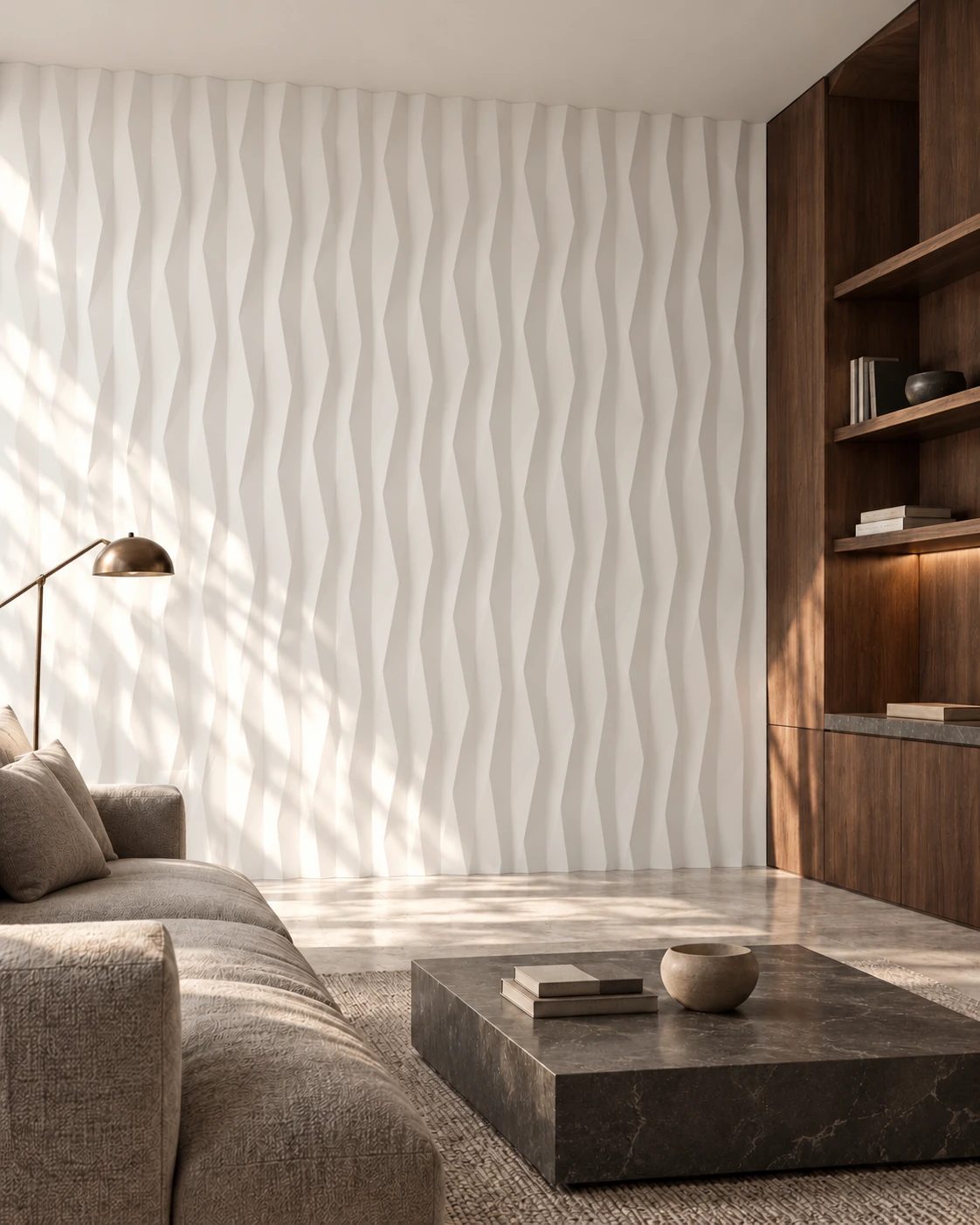 3D plaster wall panels: what they are, how to choose them and what they cost3D plaster wall panels: what they are, how they differ from PVC and MDF, the 50×50 format, where to use them, installation, reaction to fire and guide price.Read the guide →
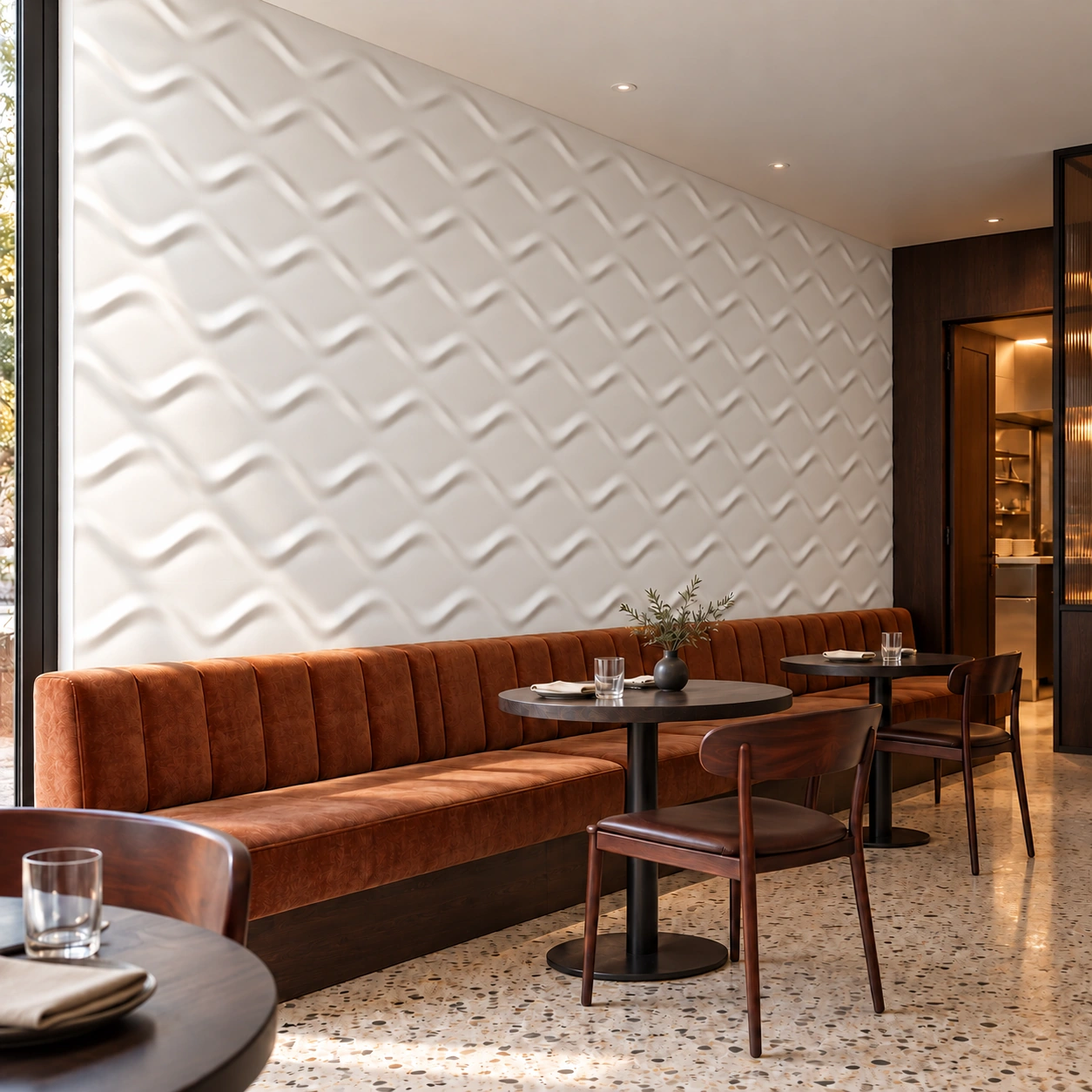 PVC vs plaster wall panels, foam or 3D tiles: the real differences and which to choosePVC vs plaster wall panels, polyurethane foam, MDF or 3D tiles: relief, joints, weight, paint, reaction to fire and which suits a rental, home or business.Read the guide →
 How to install 3D wall panels in plaster: substrate, adhesive, joints and paintHow to install 3D plaster wall panels: suitable substrates, gypsum-based adhesive, setting out, cutting, filling joints, priming and painting, step by step.Read the guide →