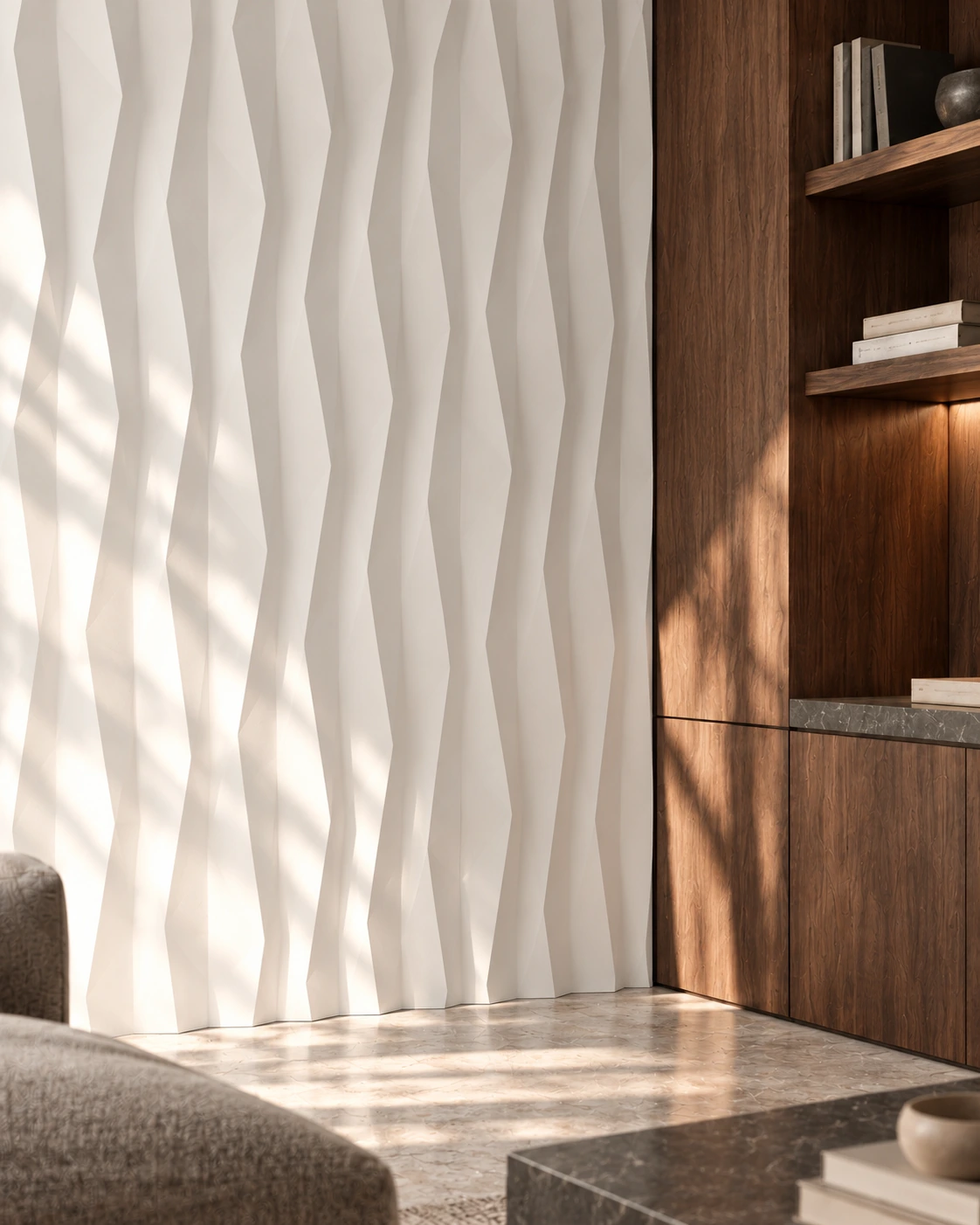
NALVEM · Guides
Feature wall panels at home: 3D ideas for the living room, bedroom, headboard and the wall behind the sofa
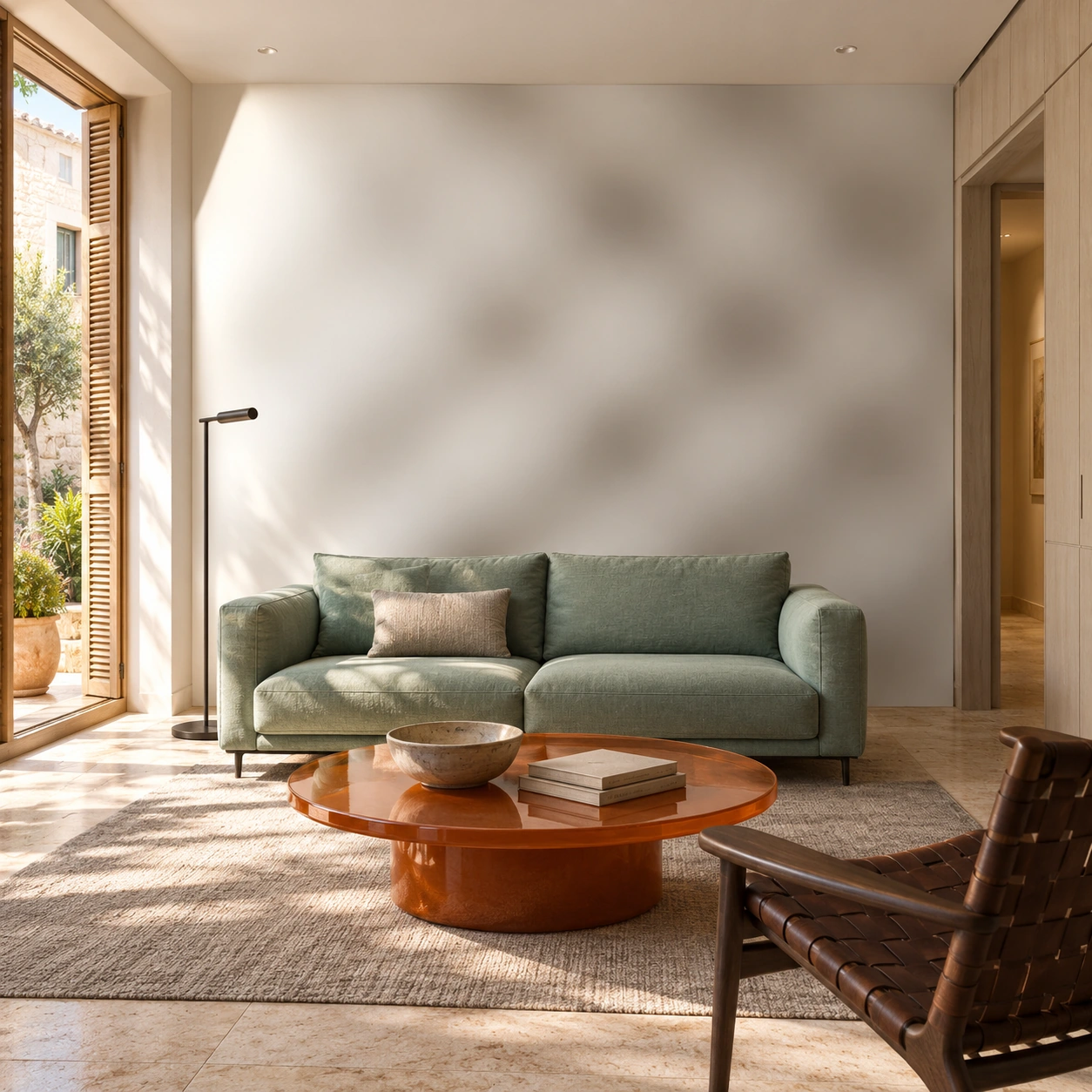
Key points
- At home, a single clad feature wall usually works better than several: the wall behind the sofa, behind the bed or in the hallway.
- NALVEM panels are made of fibre-reinforced plaster, measure 50 × 50 cm (4 per m²) and are painted on site in the colour of your choice.
- The panel is not structural: the TV, shelves and furniture stand on the floor or are fixed to an independent support, planned with the installer before fitting.
- For dry interiors only: not bathrooms, kitchen splash zones or outdoors.
- Planned guide price for the material €112/m², including Irish VAT (23%); LED designs, price on request.
You have just painted the living room and the wall behind the sofa still looks empty. Or the bedroom has a lovely bed, but the wall behind it says nothing. It is a very common situation, and it is exactly where 3D feature wall panels for the living room and for the bedroom make most sense. This guide goes room by room through which wall to choose, which design suits it, how to deal with the TV and the lighting, where not to put them and how many panels you need. We are talking about 3D plaster wall panels: made of fibre-reinforced plaster, a fine casting plaster that is the purest grade of gypsum plaster. If this is the first time you have heard of them, start with the general guide to 3D plaster wall panels.
Why one wall works better than four: the feature wall
A feature wall is the one that stands out from the rest and draws the eye. With 3D panels, the feature does not depend on colour alone: it is created by the light and shadow of the relief.
That is why cladding one wall usually works better than several. When every wall has relief, the eye has nowhere to rest and the room becomes heavy. With just one, the rest act as a frame.
How to choose the feature wall
- The one you see as you walk in or from where you spend most time: the sofa, the bed or the table.
- The one with the fewest interruptions: windows, doors and radiators break up the continuous surface.
- The one that gets side light. Raking light brings out the relief far more than frontal light.
How to create a feature wall with 3D panels
Measure the wall, choose the design, set out from a level line, bond the panels with a gypsum- or plaster-based adhesive, fill and sand the joints, then prime and paint everything. The wall should read as continuous, from corner to corner. The guide on how to install 3D plaster wall panels explains each step.
Feature wall panels for the living room: the wall behind the sofa
The wall behind the sofa is the one people search for most, and often the most difficult. A small picture falls short and shelving takes up depth and gathers clutter. A relief wall covering fills the whole wall without adding anything on top.
What to bear in mind
- Clad the whole wall, not just the width of the sofa: a rectangle behind the backrest leaves exposed edges and looks like a patch.
- The backrest hides the lower part. Choose a design that also reads from a distance and when standing.
- Watch out for rubbing. If the sofa is pushed against the wall, leave a small gap so that the backrest does not rest on the edges of the relief.
- Light from the sides. A floor lamp at one end or ceiling spotlights angled towards the wall bring out the relief at night.
Which designs suit it
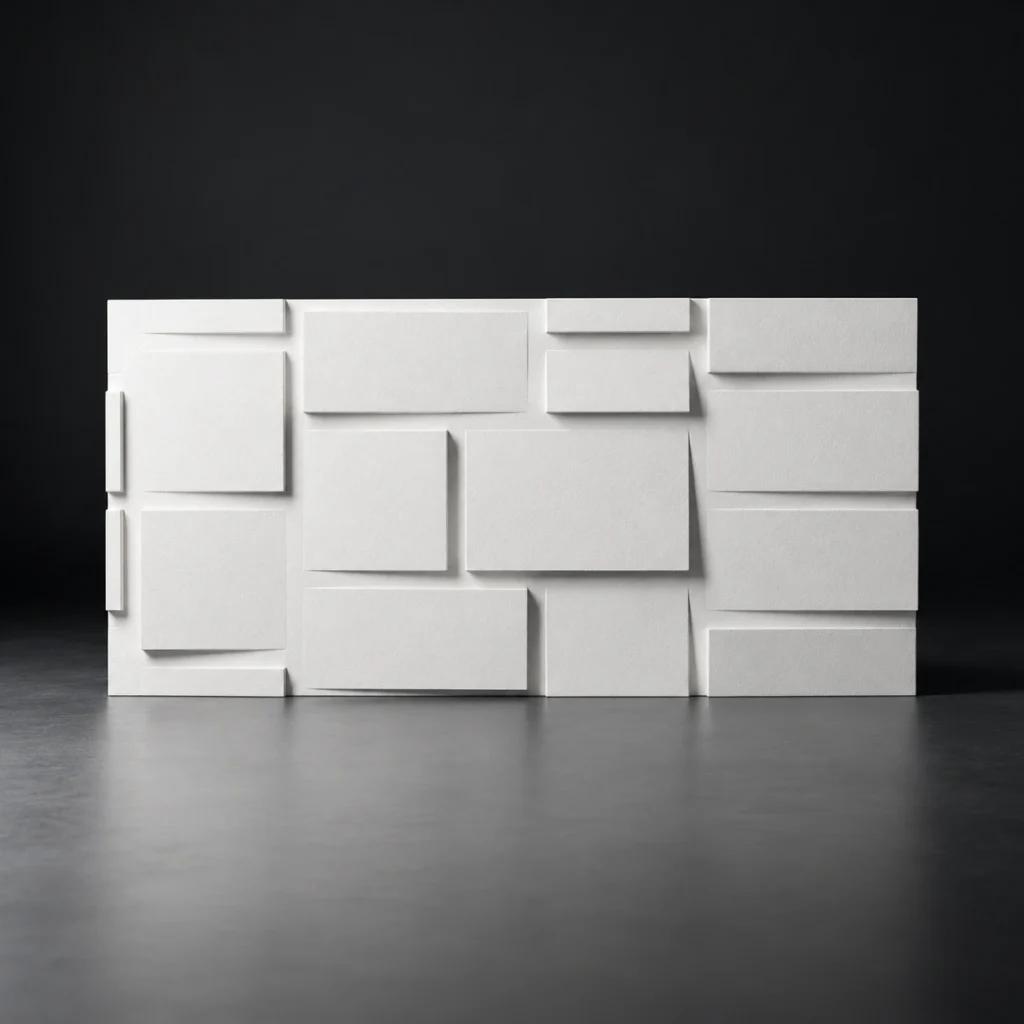
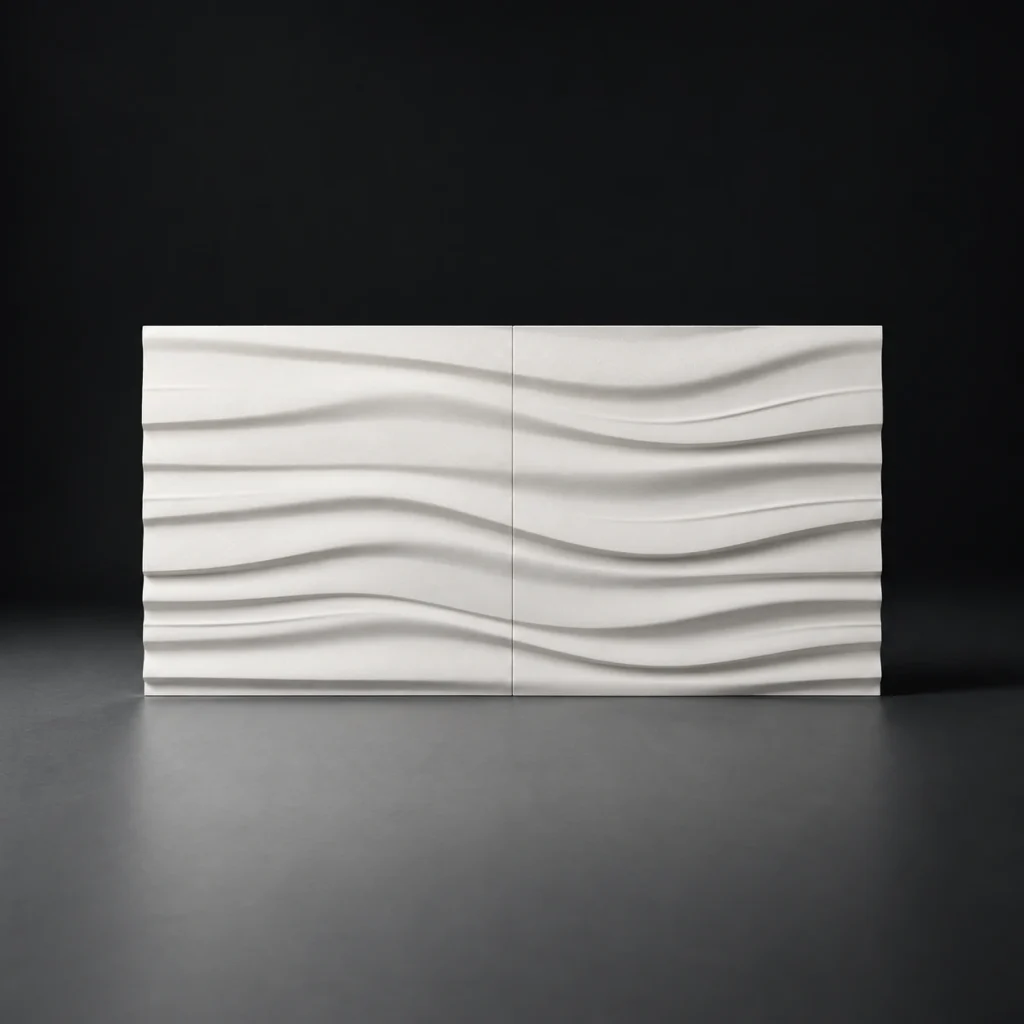
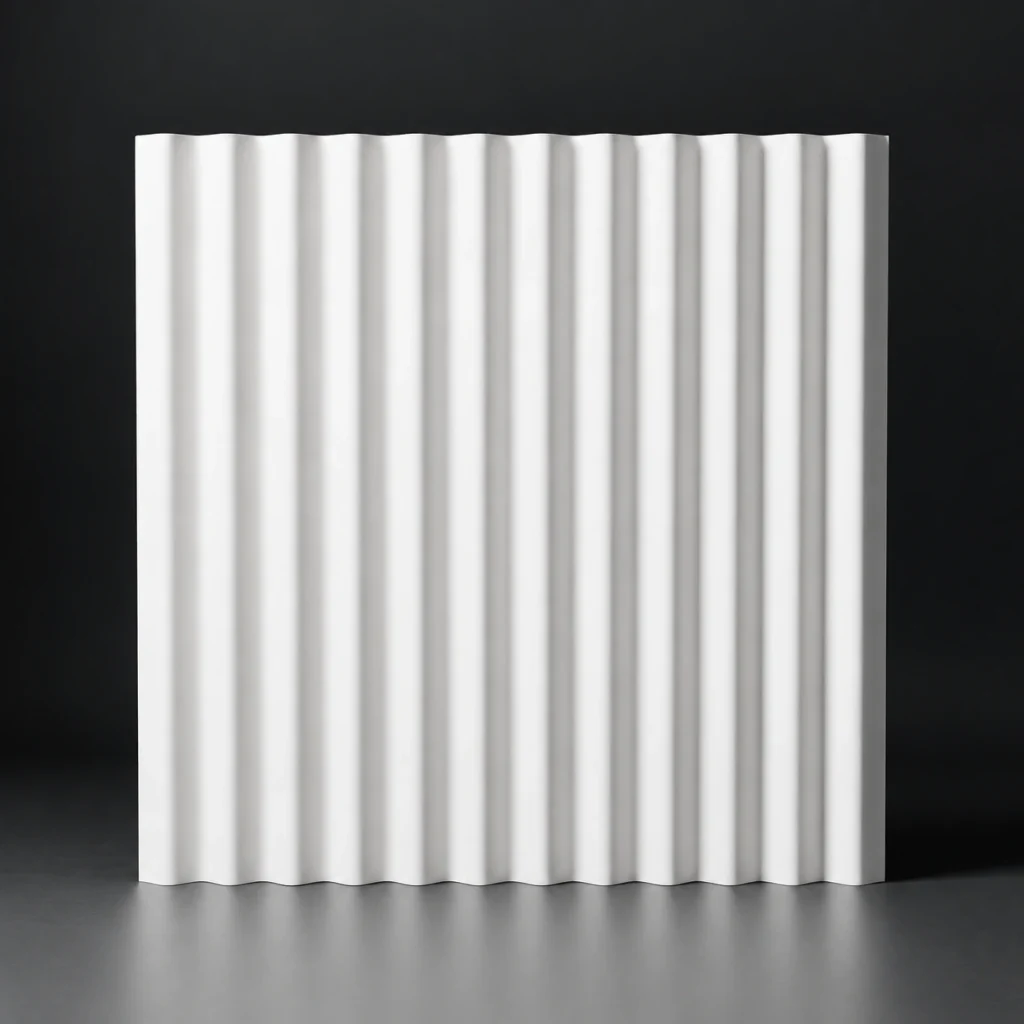
Behind the sofa, designs with a vertical direction, which elongate the wall, and broad waves, which bring calm, work well. VELIN combines four vertical folds with facets; FLUVA works with horizontal bands of varying width, useful in wide living rooms with low ceilings because they lengthen the wall. If you prefer a bolder, geometric relief, DYAREN repeats four faceted diamonds.
Living room: the TV wall
Cladding the TV feature wall helps the screen, which is a black rectangle when switched off, become part of a composition. But this wall needs planning before anything is fitted.
The TV is never hung from the panel
The panels have no structural function. Do not hang the TV, shelves or wall-hung furniture from them. There are two correct ways to deal with it:
- TV on a unit standing on the floor. This is the simplest option: the panel acts as a backdrop and supports nothing.
- TV on a wall bracket fixed to the structure of the wall through an area set aside for it. How that area is left, what fixing is used and how the junction with the panels is finished must be worked out with your installer before fitting the panels, not afterwards.
The same applies to shelves, wall lights or a floating unit: they must stand on the floor or be fixed to a support independent of the wall covering.
Cables, sockets and switches
Decide before you start where the sockets, the aerial point and the cable route will go, and have the electrician leave conduits and access boxes recessed in the wall. Once the panels are fitted, moving a socket is much more complicated.
Which designs suit it
Behind a screen, a relief that does not compete with the picture is best. The broad curves of VORA or the fine grid of TESSA, with 100 squares of 50 mm, create texture without a dominant pattern. If the wall is narrow and tall, the twelve vertical waves of RILLA emphasise the height.
You will find all the ideas, plus where to put the TV, how to route the cables and how to light the wall, in the guide to TV feature walls with 3D panels.
Feature wall panels for the bedroom: the wall behind the bed
3D panels behind the bed are one of the most rewarding applications. The bed already organises the room, and a relief behind it replaces an upholstered headboard or complements it.
Serene designs
The bedroom calls for calm. Soft waves and regular rhythms work better than strongly faceted designs, which can feel harsher at night. ONDEA, with horizontal waves in two alternating modules, and VORA, with a broad curvature, are good starting points. If you like a more architectural line, the vertical folds of VELIN also fit well.
Whole wall or partial headboard
The whole wall reads as architecture and avoids exposed edges. A partial section behind the bed is cheaper, but its top edge and sides need a clean finish; agree it with your installer before you start.
Reading light and bedside tables
- Bedside tables on each side, standing on the floor. Do not hang them from the panels.
- Table lamps on the bedside tables, or floor lamps beside them. If you prefer wall lights for reading, they must be fixed to an independent support, planned before fitting, with their power point sorted.
- Warm, side light. Lamps on both sides of the bed light the relief at a raking angle and create soft shadows, more pleasant than a spotlight from the front.
Hallway: a big effect on a small surface
The hallway is the first thing people see when they come in, and it is usually small: with just a few square metres you get real impact on a modest budget.
- Clad the main wall, the one facing the door or alongside the hall furniture.
- Designs with more relief, because they are seen up close: DYAREN or the 81 circular hollows of OCULA.
- If the corridor is narrow, vertical designs such as RILLA add a sense of height without taking up space.
- The hall unit and the mirror, standing on the floor or fixed to an independent support.
In circulation areas, a knock can chip the edges; this can be repaired with gypsum filler and paint.
Dining room: the wall facing the table
The feature wall in the dining room is the one facing the table or to one side of it. It is a room where people linger, which suits geometric relief.
- The pendant over the table lights downwards; add a light aimed at the wall to see the relief at night.
- Geometric designs such as PENTREN, with 25 faceted prisms, or AXIA, with 64 inclined planes, give an ordered backdrop with depth.
- If there is a sideboard, it should stand on the floor. Leave a small gap so that it does not rub the relief.
Home office: the background for video calls
If you work from home, the wall behind you on video calls also matters. A discreet relief looks more polished than a crowded bookcase and is not distracting.
- Fine, regular relief, such as TESSA or VANTREM, with nine faces: deep facets can give harsh shadows on camera.
- Frontal light for your face and side light for the wall, so that the relief does not flatten.
- A soft shade usually works better on camera than pure white.
Where not: bathroom, kitchen splash zones and outdoors
NALVEM panels are an interior wall covering for dry environments. They are not suitable for:
- Bathrooms and showers, not even on the wall opposite the shower, because of steam and humidity.
- The water and splash zone of the kitchen: behind the sink, the worktop and the hob.
- Outdoors: terraces, porches or façades.
- Any area with direct water or constant humidity.
In a living room with an open-plan kitchen, the walls of the living area away from water and steam are treated like any other living room wall. If you are unsure about a particular wall, ask your installer.
How to choose the design and colour for each room
The table sums up what usually works in each place. These are pointers: the result also depends on the light, the size of the wall and the furniture. You can see every family in the geometric, waves and folds and linear categories.
| Room | Desired effect | Recommended family | Example designs | Light |
|---|---|---|---|---|
| Living room, behind the sofa | Fill the wall, give it presence | Linear or waves | VELIN, FLUVA, DYAREN | Floor lamp or side ceiling spotlights |
| Living room, TV wall | Texture that does not compete with the screen | Waves or fine geometric | VORA, TESSA, RILLA | Soft indirect light; avoid reflections on the screen |
| Bedroom, behind the bed | Calm and continuity | Waves and folds | ONDEA, VORA, VELIN | Lamps on both sides of the bed, warm light |
| Hallway | Impact on a small surface | Geometric or linear | DYAREN, OCULA, RILLA | Wall light or side spotlight |
| Dining room | Order and depth | Geometric | PENTREN, AXIA | Wall light as well as the pendant |
| Home office | Discreet background on camera | Fine geometric | TESSA, VANTREM | Side light on the wall, frontal light on the face |
As for colour, they will all be supplied in matt white, with a fine mineral texture, ready to prime and paint on site with an interior paint suitable for plaster. Matt paints usually show the relief better, because they do not add sheen that muddles the shadows.
Feature wall: the same colour as the rest or different?
The same colour
This is the most architectural option: the wall stands out through its relief alone and the light creates the feature. It works very well in light shades and calm rooms, and it still fits if you change the decor.
A different colour
This strengthens the feature and makes it visible even in flat light. Mid tones, such as muted greens, greyish blues or sand shades, usually show the relief better than very dark colours, in which the shadows get lost. If you want a strong colour, test it first in the real light of the room.
With LED light at home: living room and bedroom
Some NALVEM designs are LED panels: they include a housing for a light profile. There are two systems:
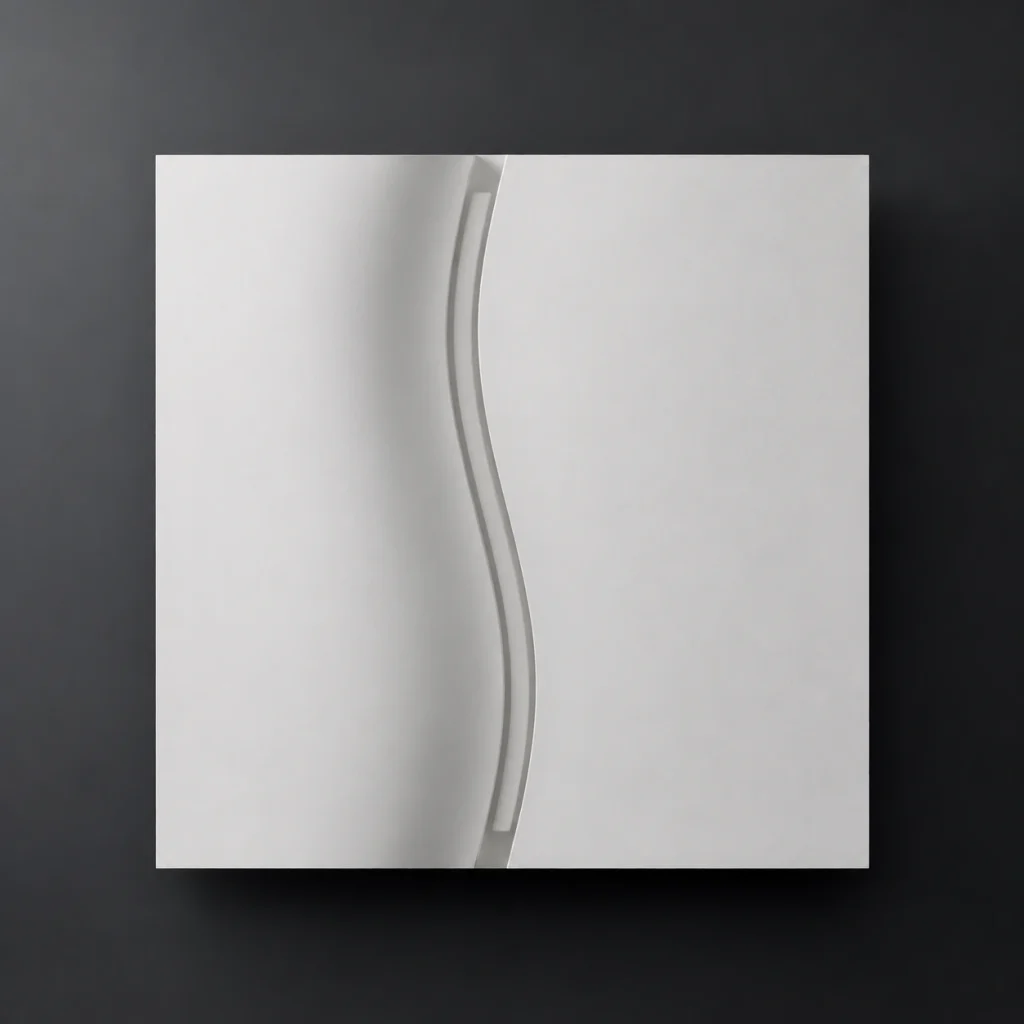
- Indirect light: the profile is hidden beneath a plaster edge or lip and only the glow is visible. At home it is usually the most comfortable option for the living room and bedroom. Examples: HOLVREA, a disc with a halo of light, or MYREN, with sinuous bands.
- Exposed linear light: the profile sits in an open groove and the line of light is part of the pattern. It suits living rooms or home offices with a graphic look; for example, LYREN.
If you are looking for a particular type of light, for example especially warm or soft, mention it in your enquiry.
Important: LED panels are planned with a silicone LED profile with integrated 24 V light and a 24 V power supply, with components to be confirmed. The power supply is connected to the mains by a qualified, authorised electrician. LED panels are priced on request. You will find more detail in the guide to 3D wall panels with LED lights and indirect lighting and every design in the LED panels category.
How many m² does a typical feature wall cover?
Each panel measures 50 × 50 cm and covers 0.25 m², so you need 4 panels per m². On top of that comes a margin for cuts and finishing; 10% is a reasonable allowance on a rectangular wall without many openings. These are guide examples for material only, with standard panels at €27.95 each (€112/m², including Irish VAT; the country selector on the website shows the price for other EU countries, and outside the EU it is on request), rounding up:
- Hallway of 1.5 × 2.5 m: 3.75 m², 15 panels; with a 10% waste allowance, 17 panels. Material from €475.15.
- Partial headboard of 2 × 1 m: 2 m², 8 panels; with waste, 9 panels. Material from €251.55.
- Whole bedroom wall of 3 × 2.5 m: 7.5 m², 30 panels; with waste, 33 panels. Material from €922.35.
- Wall behind the sofa of 4 × 2.5 m: 10 m², 40 panels; with waste, 44 panels. Material from €1,229.80.
Installation, adhesive, filler, paint, transport and, where applicable, the electrical work for LED panels are quoted separately. If the wall has windows, doors or corners, ask for the setting-out to be checked before you settle on the quantity. The guide to 3D wall panels cost per m² explains how to work out the full budget.
Frequently asked questions
What can I put on the wall behind the sofa?
The usual options are pictures, shelving standing on the floor, a different colour or a relief wall covering. 3D panels fill the whole wall without adding objects on top that need looking after. It is best to clad the whole wall, from corner to corner, choose a design that reads from a distance and add a side light so that the relief shows at night.
Do 3D panels look good in a bedroom?
Yes, especially on the wall behind the bed. Serene designs, such as soft waves or regular rhythms, work better than strongly faceted ones. Paint the wall in the same shade as the rest or in a soft colour, place floor-standing bedside tables on both sides and use warm-light lamps to light the relief from the side.
Can the TV be hung on the panels?
Not from the panels: they have no structural function. The TV goes on a unit standing on the floor or on a wall bracket fixed to the structure of the wall through an area set aside for it. That area, the fixing, the cable route and how it all meets the panels must be worked out with your installer before the wall covering is fitted.
Feature wall in the same colour or a different one?
Both options are valid. In the same colour, the relief alone creates the feature and the result is calmer and more architectural. In a different colour, the wall also stands out in flat light. Mid tones usually show the shadows better than very dark ones. Test the colour in the real light of the room before painting the whole wall.
Can they go in the bathroom?
No. NALVEM panels are made of fibre-reinforced plaster and are designed for dry interiors. They are not suitable for bathrooms, showers, kitchen splash zones, outdoors or any area with direct water or constant humidity. If you want relief in the bathroom, you need another material designed for that use; check its documentation.
How many panels do I need for a headboard wall?
It depends on the area. Each panel covers 0.25 m², so you need 4 per m², plus a waste allowance of around 10%. A partial headboard of 2 × 1 m is 8 panels, 9 with waste. A whole wall of 3 × 2.5 m is 30 panels, 33 with waste. If the wall has openings or corners, check the setting-out before ordering.
Can I fit them myself?
We recommend that installation is carried out by a professional with experience in plaster, gypsum or tiling. Setting out, bonding and filling the joints decide whether the wall looks continuous. If you have experience with these materials, the installation guide explains the process. Wear a mask and goggles when cutting or sanding, and respect each manufacturer’s drying times.
Next step
Choose the wall, measure it and pick two or three designs from the full catalogue. On each design’s page you can join the sample waiting list with ‘Request a sample’ or send your enquiry with the measurements; you can also use the enquiry form. If you are interested in fire performance, read the guide to the class A1 reaction to fire rating, and if you are undecided between materials, the comparison of plaster, PVC and 3D tiles. If your project is for commercial premises, see the ideas for restaurants, hotels, offices and shops; if you are a professional, the guide for architects and interior designers. You will find them all in the guides index.
More guides
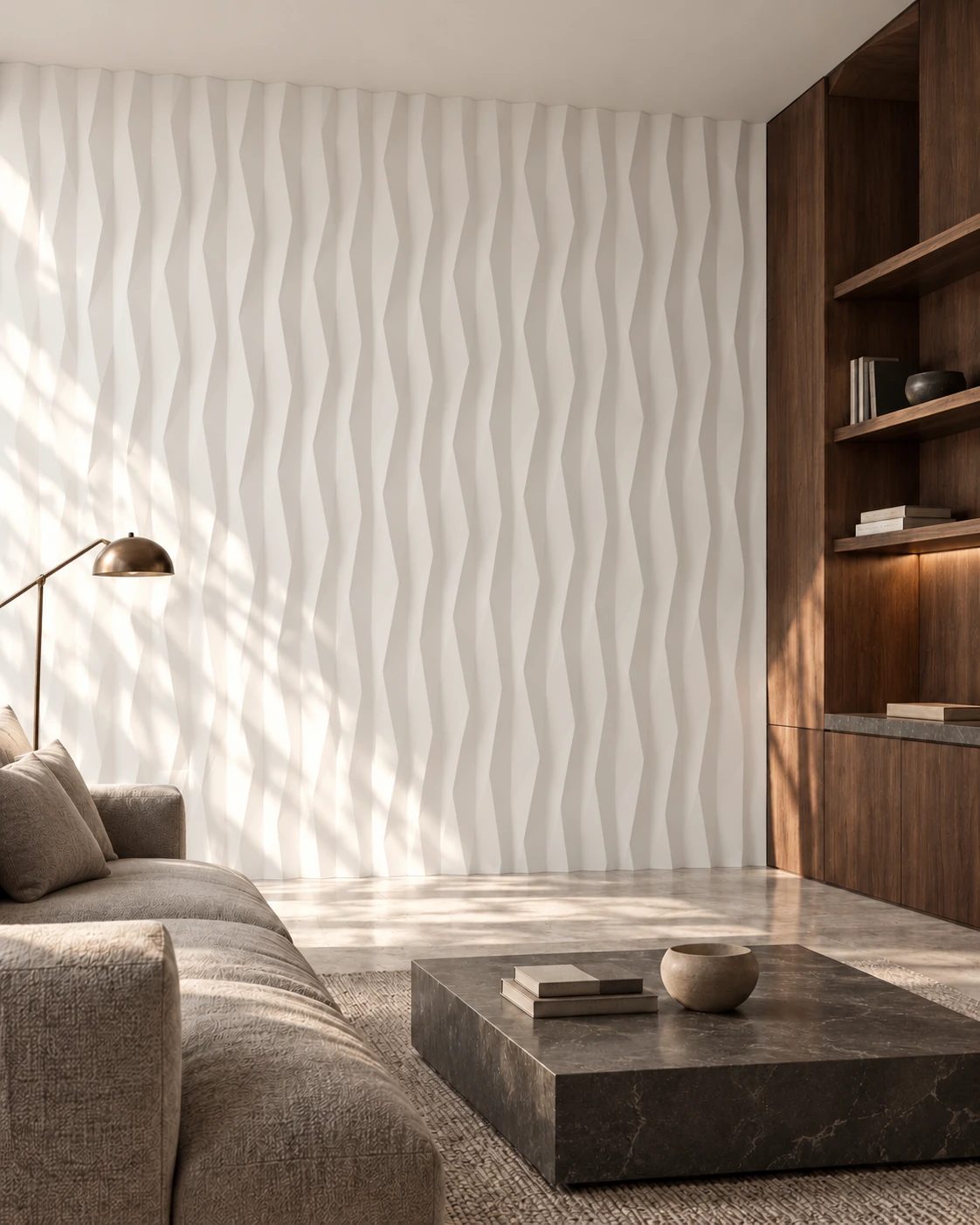 3D plaster wall panels: what they are, how to choose them and what they cost3D plaster wall panels: what they are, how they differ from PVC and MDF, the 50×50 format, where to use them, installation, reaction to fire and guide price.Read the guide →
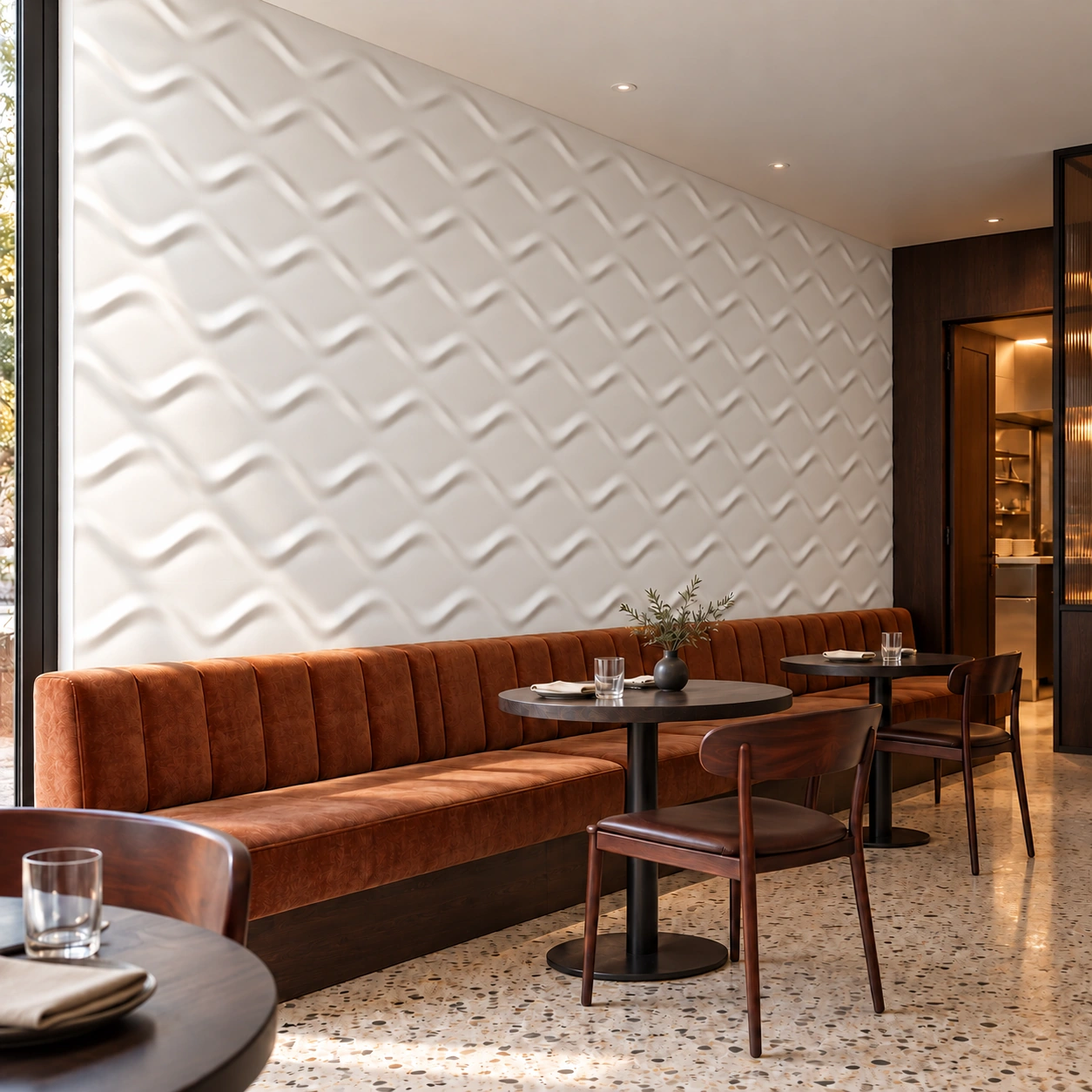 PVC vs plaster wall panels, foam or 3D tiles: the real differences and which to choosePVC vs plaster wall panels, polyurethane foam, MDF or 3D tiles: relief, joints, weight, paint, reaction to fire and which suits a rental, home or business.Read the guide →
 How to install 3D wall panels in plaster: substrate, adhesive, joints and paintHow to install 3D plaster wall panels: suitable substrates, gypsum-based adhesive, setting out, cutting, filling joints, priming and painting, step by step.Read the guide →