NALVEM · Guides
Euroclass A1 reaction to fire: what it means and which decorative panels achieve it
Key points
- Euroclass A1 is the highest reaction to fire class in the EN 13501-1 standard: the product makes no contribution to fire.
- A1 carries no smoke (s) or droplet (d) indicators; A2, B, C and D do.
- It is obtained through testing or, for certain mineral materials with little organic matter, through classification without the need for testing.
- PVC, polyurethane foam and MDF are organic materials: they cannot use the A1-without-testing route.
- The class required in each area of a building is set by the building regulations of each country and the project designer, according to the use.
You are preparing a specification for a hotel reception, an office corridor or the refurbishment of commercial premises, and one line keeps appearing in the documents: ‘wall linings, Euroclass A1’. Or you are a homeowner who has seen the label on a decorative panel and wants to know what Euroclass A1 means before buying. In this guide we explain how the reaction to fire Euroclasses work, how A1 differs from A2, what role building regulations play, how the class is obtained and which document you should ask for to check it. At the end you will see where NALVEM plaster panels currently stand on reaction to fire.
The EN 13501-1 Euroclasses, from A1 to F
Reaction to fire describes how a material behaves when exposed to a flame: whether it ignites, how much heat it gives off, how much smoke it produces and whether it drips burning material. It is not the same as fire resistance, which measures how long a complete element, such as a wall or a door, keeps performing its function.
In Europe it is classified under the EN 13501-1 standard, which replaced the national classifications. In Spain, for example, this meant leaving behind the old M0, M1, M2… classes, which are still sometimes mentioned on Spanish building sites out of habit. Today the valid reference is the Euroclass.
There are seven main classes for construction products (excluding floorings). This table sums up their general meaning:
| Euroclass | General description | Smoke and droplets | Typical examples |
|---|---|---|---|
| A1 | Non-combustible. No contribution to fire at any stage. | Not stated: it is considered not to produce significant smoke or droplets. | Natural stone, concrete, ceramics, glass, gypsum plaster without organic coatings. |
| A2 | Non-combustible or of very limited combustibility. Very limited contribution to fire. | Always with s1, s2 or s3 and d0, d1 or d2. | Mineral products with a small organic part or a thin facing. |
| B | Combustible, with a very limited contribution to fire. | Always with s and d. | Some treated or composite products. |
| C | Combustible, with a limited contribution to fire. | Always with s and d. | Depends on the product and its treatment. |
| D | Combustible, with a medium contribution to fire. | Always with s and d. | Depends on the product and its treatment. |
| E | Combustible, with a high contribution to fire. | May carry the d2 indicator. | Products that only pass the small flame test. |
| F | Performance not determined or not reaching class E. | Not stated. | Unclassified products. |
The examples are indicative: the class of each product is set by its documentation, not by the family of material. Floorings have a parallel scale with the subscript ‘fl’ (A1fl, Bfl…); for wall panels, the scale in the table applies.
What s1–s3 and d0–d2 mean
Except for A1, F and part of E, the Euroclass carries two additional indicators, as in ‘B-s1,d0’. They read as follows:
Smoke production: s1, s2 and s3
- s1: low smoke production.
- s2: medium smoke production.
- s3: high or unlimited smoke production.
Smoke reduces visibility during evacuation and is toxic. On escape routes and in public areas, the ‘s’ indicator matters as much as the letter.
Flaming droplets or particles: d0, d1 and d2
- d0: no flaming droplets or particles are produced.
- d1: flaming droplets or particles are produced, but they do not persist beyond a limited time.
- d2: flaming droplets or particles are produced without that limit.
Burning droplets can spread fire downwards, which is relevant for ceilings.
Why A1 has no s or d
An A1 product makes no contribution to fire, so it is not given smoke or droplet indicators. An expression such as ‘A1-s1,d0’ is not correct: class A1 is written on its own.
A1 or A2: the differences
This is a frequent question in specification, especially for ceilings and common areas. Both classes are considered non-combustible or of very limited combustibility, but they are not equivalent:
- Contribution to fire. A1 makes no contribution at any stage of a fire, not even when the fire is fully developed. A2 makes a very limited contribution, but it does exist.
- Smoke and droplets. A2 always comes with s and d, for example A2-s1,d0. An A2-s3,d2 does not behave the same way as an A2-s1,d0 on an escape route.
- Tests. A1 is supported by non-combustibility tests (EN ISO 1182) and calorific value tests (EN ISO 1716). A2 also adds the single burning item test (EN 13823, known as SBI), which is where the s and d indicators come from.
- Typical materials. A mineral product without significant organic matter usually ends up as A1. With an organic binder, paper or a plastic finish, it usually drops to A2 or lower classes.
When is A2 enough? It depends on the regulations for each area and on the designer. A1, as the highest class, meets any reaction to fire requirement. If the specification says ‘A1’, an A2 product is not a valid alternative without the designer’s express approval.
What building regulations require for the reaction to fire of wall linings
The building regulations of each country govern fire safety and, together with the project designer, determine the minimum reaction to fire class of wall, ceiling and floor linings for each area of the building: for example occupiable rooms, protected corridors and stairs, special risk rooms, or concealed spaces such as ceiling voids and service shafts.
Some general ideas worth bearing in mind:
- The requirement changes from one area to another. A bedroom in a home is not the same as a hotel lobby, a protected stairway or premises open to the public.
- Ceilings and walls may have different requirements, as may exposed linings and those inside concealed spaces.
- Building regulations set a minimum. Regional or local rules, by-laws, a hotel chain’s specification or an insurer may ask for more.
- Decorative items count too: a bonded 3D panel is part of the wall lining.
We do not reproduce the tables of any regulation: the requirement depends on the use, the area, the version in force and other rules. The class each surface needs is determined by the project designer. Your role is to check that the chosen product is backed by a valid document for that class.
How Euroclass A1 is obtained
There are two routes to declaring class A1. Both are legitimate, but they are supported by different documents.
Testing and a classification report
This is the general route: a laboratory tests samples of the product. For A1 these are mainly the non-combustibility test (EN ISO 1182) and the calorific value test (EN ISO 1716). With the results, the laboratory issues a classification report under EN 13501-1, which identifies the product tested, its composition, its thickness and the end-use conditions it applies to.
If the product falls within the scope of a harmonised European standard, it must also carry CE marking and a declaration of performance stating its reaction to fire class.
Classification without the need for testing
The European Union recognises that some materials have a known, stable behaviour. That is why Commission Decision 96/603/EC (as amended by Decisions 2000/605/EC and 2003/424/EC) publishes a list of products that are classified as A1 without the need for testing. In Spain, for example, the list is incorporated into Royal Decree 842/2013, which governs the classification of construction products by reaction and resistance to fire.
The list includes mineral materials such as concrete, natural stone, ceramic products, glass, metals and gypsum, with conditions. The main one is common to all of them: the product may not contain more than 1.0% organic matter, by weight or by volume (whichever is more onerous), evenly distributed. In addition, it may only be made of the materials and additives the list allows for that family.
This route is limited to the materials on the list and the configuration described. If an organic coating is added or the limit is exceeded, it no longer applies and testing would be needed.
Why plaster is A1 and PVC, foam or MDF are not
Gypsum is hydrated calcium sulphate, a mineral. It does not burn: when heated it releases the water from its crystal structure, and that process absorbs heat. That is why gypsum and fine casting plaster, its finest and purest grade, are on the list of A1 materials without testing, as long as the organic matter does not exceed 1.0%.
PVC, polyurethane foam and MDF are organic materials: plastic polymers in the first two cases and wood fibres bound with resin in the third. All of them are combustible to a greater or lesser degree. This has two practical consequences:
- They cannot use the A1 classification without testing, because their organic content is far above 1.0% and they are not on the list.
- Their class depends on the specific product: additives, thickness, substrate and finish change the result. Check the manufacturer’s documentation.
If you are comparing materials for a decorative wall, the comparison of 3D plaster, PVC and tile wall panels also covers other criteria, such as finish, repair and use in damp areas.
Paint and the fire class
Plaster panels are usually painted on site, and most paints are an organic film of resins, additives and pigments. Is the painted wall still A1?
Class A1 without testing applies to the piece without organic coatings. Primer and paint applied on site are an additional coating, and their behaviour depends on the product, the number of coats and the film weight. To manage this properly:
- If the area has a reaction to fire requirement, ask the project designer what treatment the finish allows.
- Check the paint documentation. Some manufacturers declare the class of the painted system on a given type of substrate; others do not.
- Avoid building up coats unnecessarily and use an interior paint suitable for plaster, as the NALVEM installation guide indicates.
- Do not mix up concepts: the class of the panel and that of the painted system are two different things. The panel being A1 does not on its own guarantee the class of the finished wall.
How to check a panel’s class before buying: which document to ask for
A Euroclass on a sales sheet is not enough: ask for the document that supports it and check that it matches the product you are going to install.
Documents according to the classification route
- If the class comes from testing: the EN 13501-1 classification report issued by a laboratory and, if the product carries CE marking, the declaration of performance.
- If the class comes from classification without testing: a manufacturer’s declaration citing the legal basis (Commission Decision 96/603/EC and, where applicable, the national provision that incorporates it, such as Spain’s Royal Decree 842/2013), the section of the list that applies, the organic content and the conditions of use.
What to check in every case
- That the document identifies the product: name, material, thickness or range.
- That the class is complete: if it is not A1, it must include s and d.
- The conditions of application: substrate, fixing method, finish, whether or not coatings are included.
- That the class is the one from the European standard, not an old national class or an expression such as ‘fireproof’, ‘fire retardant’ or ‘does not spread flame’, which are not Euroclasses.
- That the intended finish does not fall outside the scope of the document, especially if it is going to be painted or coated.
If something does not add up, ask before you confirm the order.
Reaction to fire of NALVEM panels: where things stand
NALVEM’s 3D plaster wall panels are made of fibre-reinforced plaster: plaster, water and reinforcing fibre. The collection is in preparation and we are defining the formulation to meet the conditions for A1 classification without testing. Until this is documented, we do not declare a class for the product.
Intended basis
The classification would be based on Commission Decision 96/603/EC, as amended by Decisions 2000/605/EC and 2003/424/EC, and on Annex I, section 1.2, of Royal Decree 842/2013 (which adopts it into Spanish law), which includes gypsum and gypsum-based plasters with additives such as fibres, provided that the organic content does not exceed 1.0%. The reaction to fire declaration will be published once the composition has been documented.
Conditions that will apply
- It would apply to the piece as supplied: in matt white, without factory-applied organic coatings.
- Primer and paint applied on site are an additional coating whose behaviour depends on the product you choose.
- The intended use is interior wall lining in a dry environment, as stated in the general technical data sheet.
What it is not
A formulation target is not a declared class, nor is it a test report or CE marking. If your project expressly requires a laboratory report, discuss it with the project designer before deciding.
Which designs it will affect
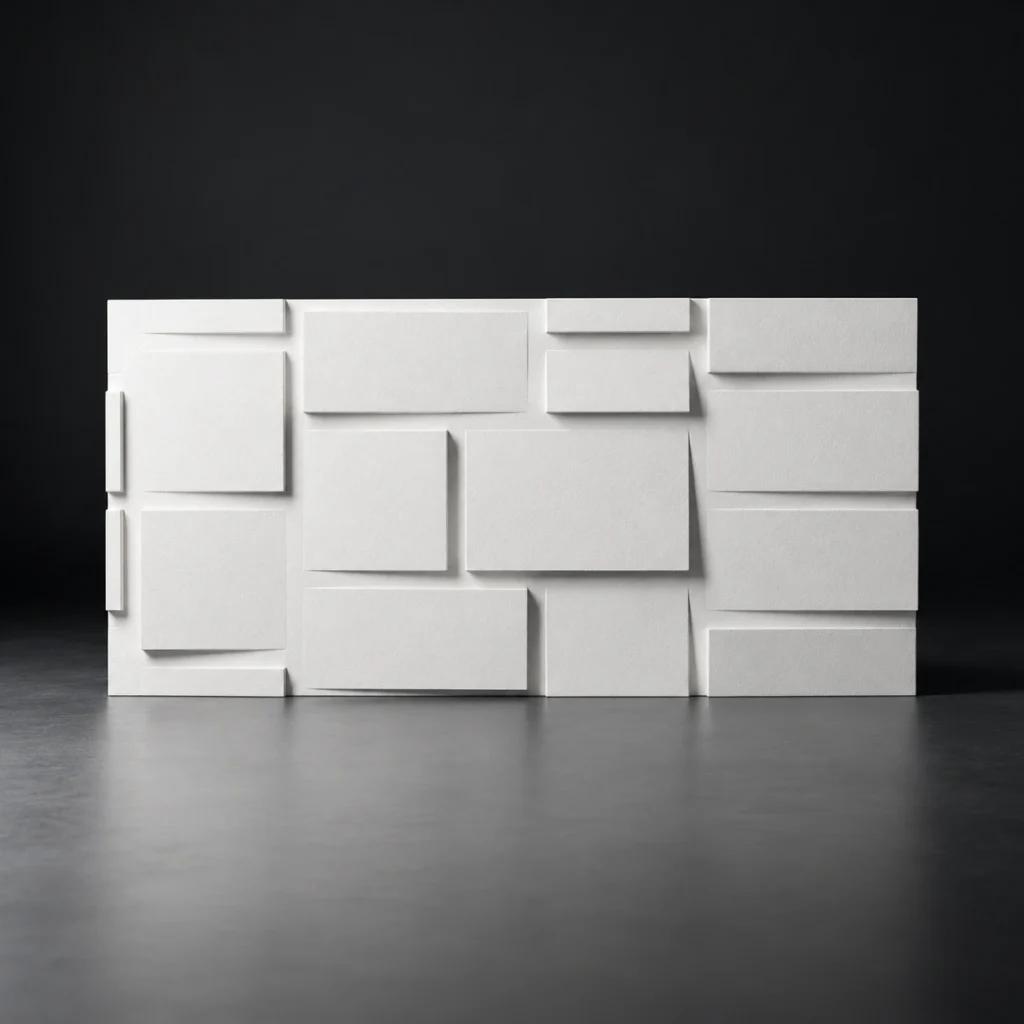
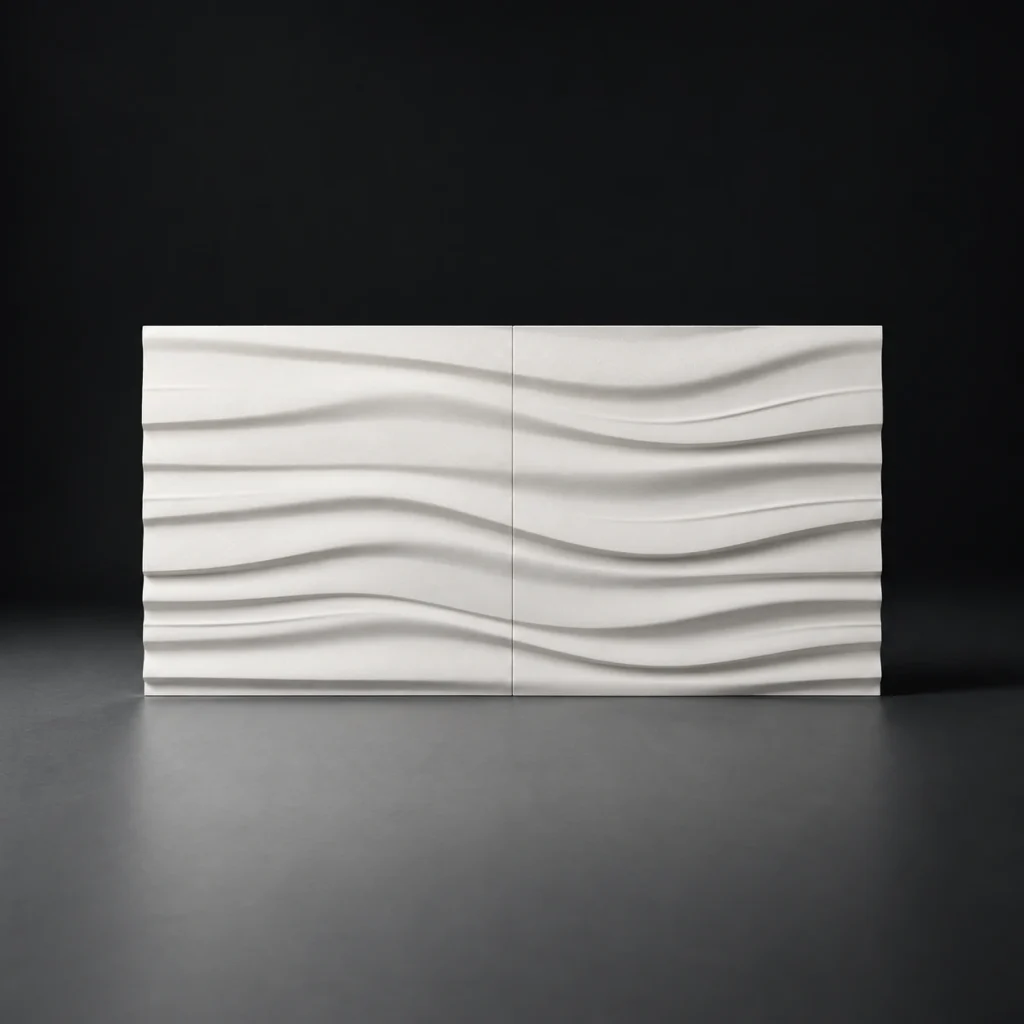
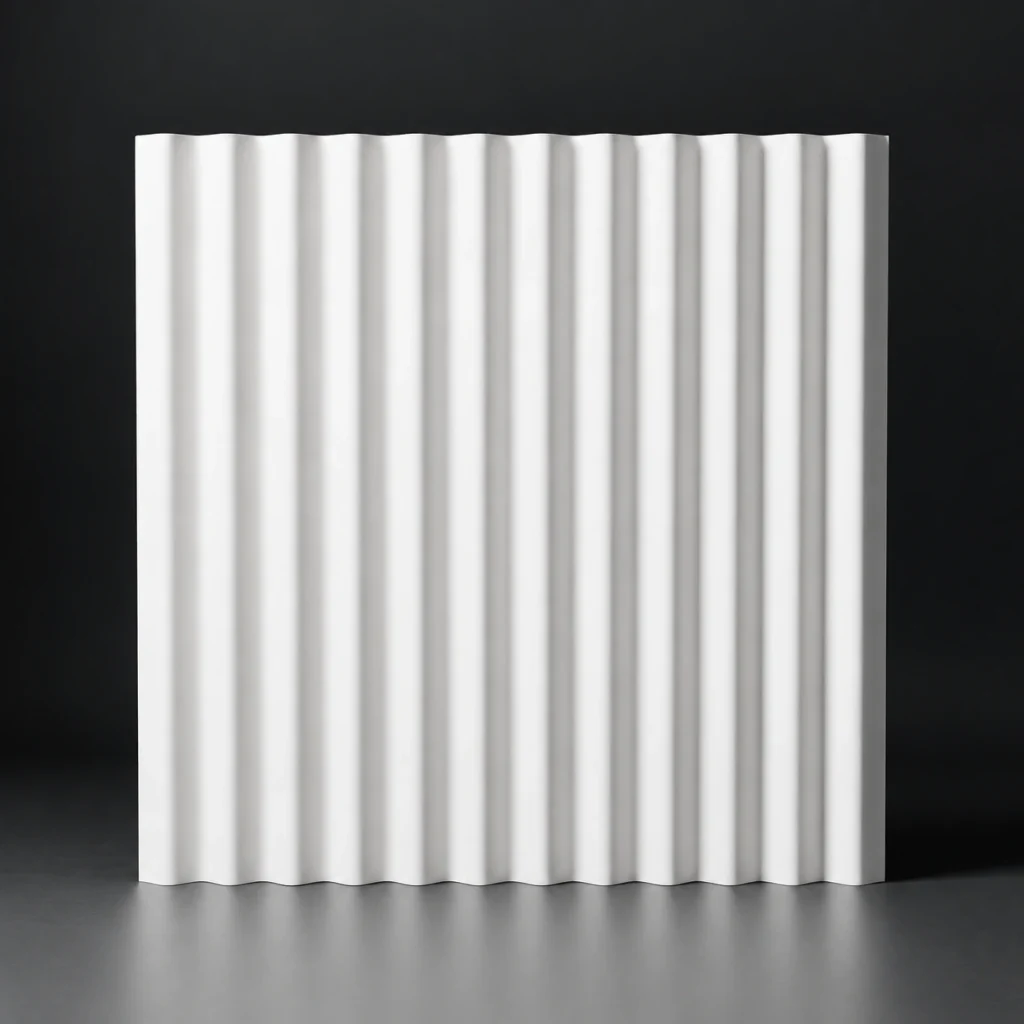
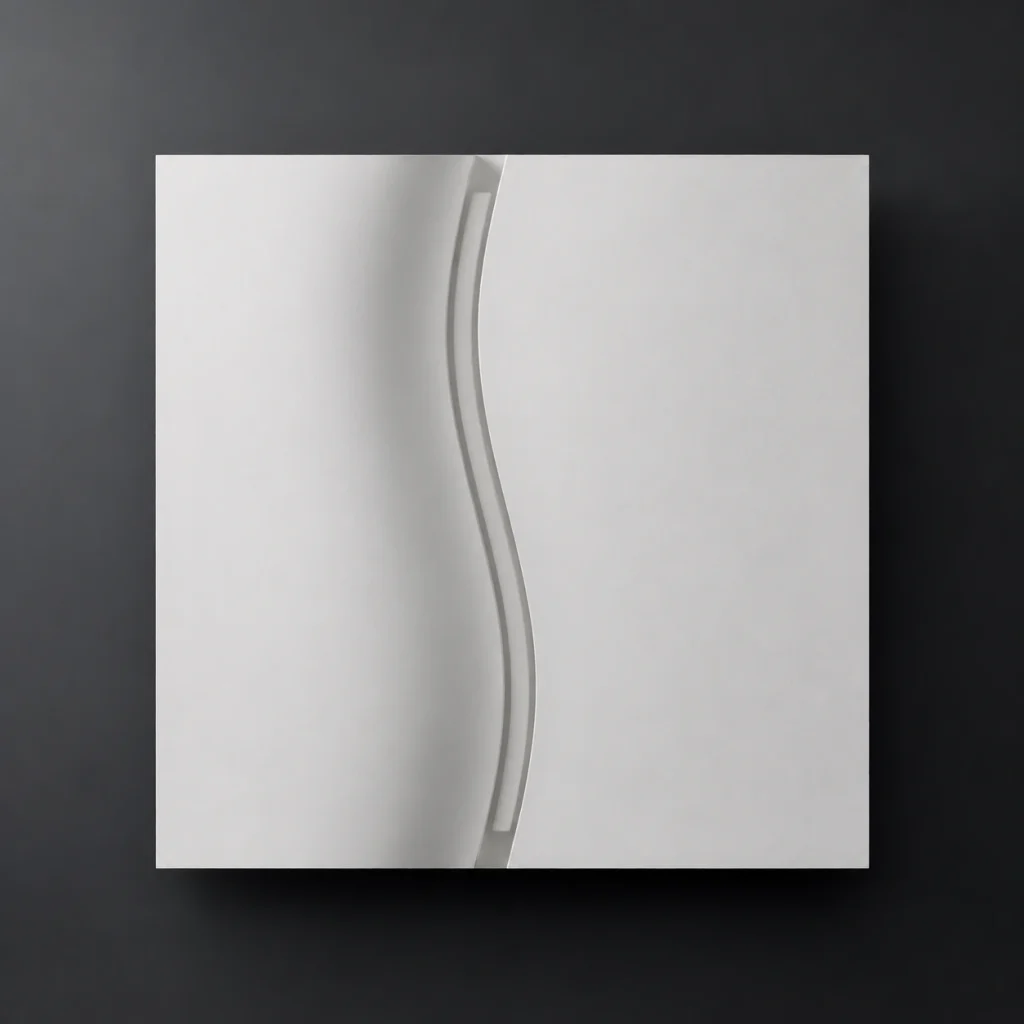
The class will depend on the material of the pieces, which will be the same in every design: geometric designs such as KELDRYN or TESSA, linear ones such as VELIN and wave and fold designs. In LED panels, such as KYREVA, the class will be documented for the plaster piece only. The planned LED profile and electronics will not be part of it; we explain this in the guide to 3D wall panels with LED lights.
The panels have no structural function and are not suitable for bathrooms, showers or exteriors. For installation, see how to install 3D plaster wall panels.
Frequently asked questions
What does A1 mean?
A1 is the highest reaction to fire class in the European standard EN 13501-1. It indicates that the product makes no contribution to fire at any stage: it gives off no appreciable heat and does not spread flame. That is why it carries no smoke or droplet indicators. It applies to mineral materials such as stone, concrete, ceramics or gypsum plaster without organic coatings, provided their documentation proves it.
Is A1 the same as non-combustible?
In practice, yes: an A1 product is considered non-combustible. But it is better to use the standard’s term, ‘Euroclass A1’, because ‘non-combustible’ on its own is not an official classification and each manufacturer may understand it in its own way. In addition, the class refers to the product under the conditions described in its document. A later organic coating, such as paint or vinyl, may change the behaviour of the whole.
A1 or A2 for ceilings?
It depends on the use of the building and the area: regulations set the minimum reaction to fire class of wall, ceiling and floor linings, and ceilings and walls may have different requirements. The class required is determined by the project designer. What is certain is that an A1 product meets any reaction to fire requirement, because there is no higher class. If you are asked for A2, an A1 product is also valid.
Does painting change the class?
It may change the class of the whole. Class A1 without testing applies to the piece without organic coatings, and most paints are organic films. The result depends on the paint, the number of coats and their film weight. If the area has a specific requirement, consult the project designer and check the paint manufacturer’s documentation, which sometimes declares the class of the painted system.
Are PVC panels A1?
They cannot be A1 through classification without testing, because PVC is an organic material and far exceeds the limit of 1.0% organic matter. Like other plastics, it is combustible to a greater or lesser degree. Its real class depends on each product, its additives and its thickness, so check the manufacturer’s documentation and ask for the corresponding classification report.
Is A1 compulsory in a hotel?
There is no single answer. The building regulations of each country set minimum reaction to fire classes according to the area of the building: a guest room does not have the same requirement as a lobby, a protected corridor or a stairway. In addition, regional or local rules, the chain’s specification or the insurer may ask for more. The class required for each surface is determined by the project designer.
What is classification without testing?
It is a route provided for in Commission Decision 96/603/EC and incorporated in Spain into Royal Decree 842/2013. It allows certain materials of known behaviour, such as gypsum, stone or concrete, to be classified as A1 without laboratory testing, provided they meet the conditions of the list, above all a maximum organic content of 1.0%. It is supported by a manufacturer’s declaration, not by a test report.
Next step
If you are preparing a project, ask the designer responsible for the project which class each area requires and let us know. Then choose the design in the full catalogue, work out the material with the guide to cost per square metre or send us your project through the enquiry form. If you would like to know more about the brand, visit About NALVEM, and you will find the rest of the content in the guides index.
More guides
 3D plaster wall panels: what they are, how to choose them and what they cost3D plaster wall panels: what they are, how they differ from PVC and MDF, the 50×50 format, where to use them, installation, reaction to fire and guide price.Read the guide →
 PVC vs plaster wall panels, foam or 3D tiles: the real differences and which to choosePVC vs plaster wall panels, polyurethane foam, MDF or 3D tiles: relief, joints, weight, paint, reaction to fire and which suits a rental, home or business.Read the guide →
 How to install 3D wall panels in plaster: substrate, adhesive, joints and paintHow to install 3D plaster wall panels: suitable substrates, gypsum-based adhesive, setting out, cutting, filling joints, priming and painting, step by step.Read the guide →